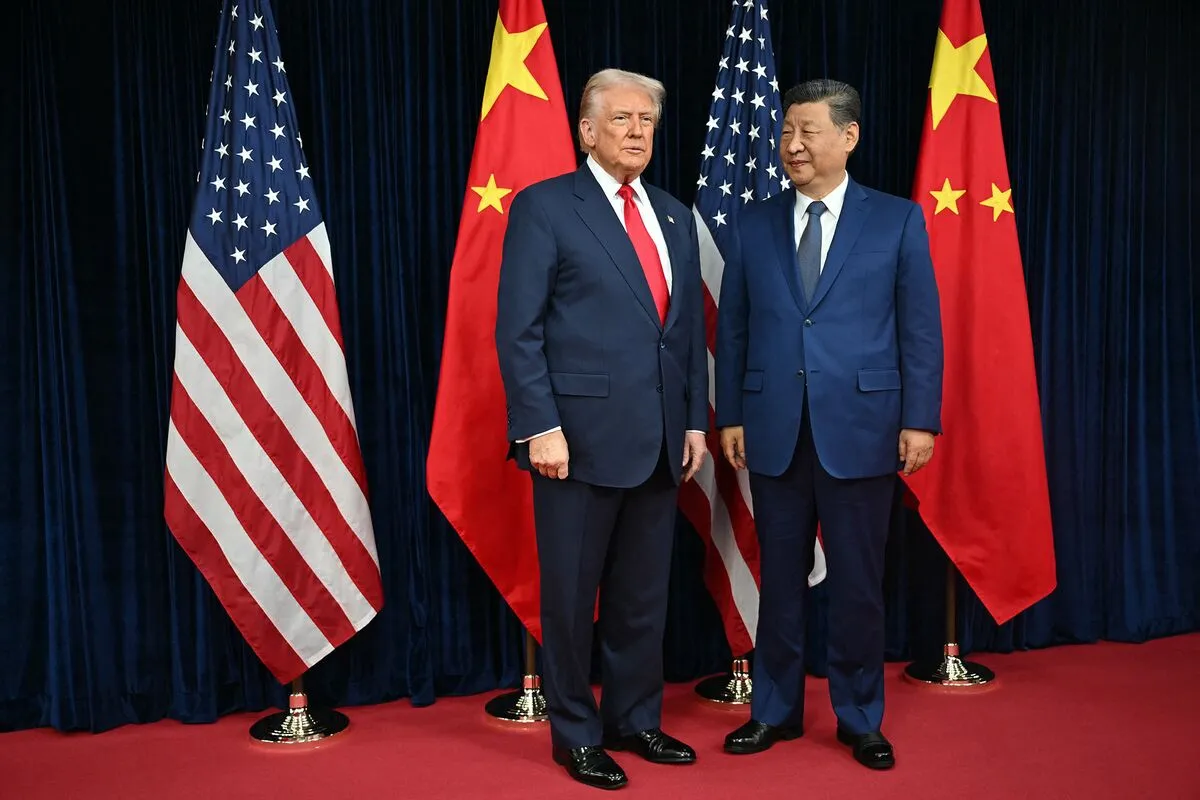
In a dramatic turn of events at the Asia‑Pacific Economic Cooperation (APEC) summit in Busan, South Korea, U.S. President Donald Trump and Chinese President Xi Jinping emerged from a tête-à-tête described by Trump as an “amazing meeting,” announcing a significant recalibration of sweeping tariffs on Chinese imports. Under the deal, tariffs that had surged to an average of 57 % will be rolled back to 47 %. (Reuters)
The outcome represents a pivotal moment in the trade relationship between the two largest economies in the world, yet analysts caution that this may be more of a tactical truce than a fundamental reset. The cascading effects are already reverberating through global markets, agricultural trade, raw-materials flows and geopolitical alignments.
Build the future you deserve. Get started with our top-tier Online courses: ACCA, HESI A2, ATI TEAS 7, HESI EXIT, NCLEX-RN, NCLEX-PN, and Financial Literacy. Let Serrari Ed guide your path to success. Enroll today.
What the Deal Entails
During the summit, held on the sidelines of the APEC meeting, Trump announced that the U.S. would reduce tariffs on Chinese goods from 57 % to 47 % in exchange for a series of concessions from Beijing. These include:
- China’s commitment to resume large-scale purchases of U.S. soybeans. (AP News)
- A pledge to continue exports of rare earth elements and delay new restrictions. (The Washington Post)
- A wholesale crackdown by Beijing on the illicit trade of fentanyl and its precursor chemicals. Trump specifically highlighted China’s agreement to “work very hard to stop the flow” of fentanyl precursors into the U.S. market. (Reuters)
- The suspension (for twelve months) of ship-fees and maritime-logistics disciplinary measures between the U.S. and China. (Reuters)
Trump characterised the summit as delivering a “12 out of 10” in success, while Xi noted that trade should serve as both “ballast and propeller” of bilateral relations. (The Washington Post)
One of the sharpest pivots came around fentanyl-related tariffs: the U.S. had imposed a 20 % levy tied to fentanyl precursor trade, which Trump said would be immediately reduced to 10 %. This reduction accounts for much of the broader 10-point tariff cut. (Reuters)
Market and Global Reactions
Global equity and commodity markets responded swiftly to the announcement. Although sentiment improved, the reaction was mixed given lingering questions around sustainability and depth of the deal. For example, oil prices were little changed despite hopes of improved growth, signalling caution among energy traders. (Reuters)
In Asia, the Shanghai Composite Index slipped after hitting a 10-year high ahead of the meeting, while soybean futures in the United States declined on some profit-taking despite the Chinese purchase commitment. (Reuters)
Why Now? Drivers of the Deal
Several converging factors set the stage for this summit and tariff reduction.
Supply-Chain Pressures and Rare Earths
China dominates production of rare earth elements and magnets—critical for global electronics, defence and clean-energy supply chains. The U.S. has flagged concerns about Beijing’s export-controls strategy, and in the run-up to the summit Trump had threatened 100 % tariffs unless Beijing relented.
Beijing’s willingness to guarantee continued rare-earth exports for at least the next year helped unlock the tariff cut. The U.S. side explicitly tied the rare-earth guarantee to the deal.
Fentanyl Crisis and Political Imperative
The U.S. remains embroiled in an opioid-overdose epidemic, with fentanyl contributing heavily. Trump leveraged this humanitarian and domestic-political issue in the summit, making fentanyl control a central bargaining chip. The tariff reprieve on fentanyl-linked imports therefore has both economic and political signalling value.
U.S. Domestic Economy & Agriculture
American farmers, especially soybean producers, have been major casualties of the protracted U.S.–China trade standoff. China’s renewed purchase commitment is a lifeline for U.S. agriculture. Trump also emphasised the agriculture dimension in his post-meeting remarks. (The Economic Times)
Rising Risks of a Trade War Spiral
The escalations earlier this year—including threats of tariffs up to 145 % on Chinese goods and China’s retaliatory measures—fostered an environment increasingly risky for global growth. The deal offers a cooling-off interval and gives both sides breathing space. (Reuters)
What This Means – Short-Term and Structural Impacts
Immediate Effects
- The U.S. will reduce its tariff burden on Chinese imports, improving the economics for importers and retailers.
- China’s agricultural exports to the U.S. (soybeans) are expected to ramp up, helping U.S. farmers and easing trade tension in the farm belt.
- Rare earth-related supply-chain fears ease temporarily, supporting industries dependent on Chinese magnet/rare earth materials.
- Market sentiment improves modestly—but the reaction remains cautious given unresolved structural issues.
Medium to Long-Term Implications
For U.S.–China Trade Relations
The deal may mark the beginning of a managed détente rather than complete disengagement. For now, tariffs remain very high (47 %), and both sides have carved out specific concessions rather than sweeping reforms. It sets the stage for an annual renegotiation, as Trump indicated. (The Washington Post)
The fact that technology, Taiwan and high-end chip exports were not resolved signals that decoupling risks may remain elevated—even if surface tensions ease. The post-summit commentary emphasised that deeper structural issues remain unaddressed. (AP News)
For U.S. Domestic Economy and Global Supply Chains
Reduced tariff burdens mean American importers of Chinese goods may see improved margins or lower prices—though the high 47 % rate still means heavy protection. U.S. agricultural producers benefit from revived access to the Chinese market.
Global supply chains tied to rare earths, electronics and clean-energy manufacturing receive a temporary reprieve. But underlying issues of dominance and dependency remain: China still holds a strong hand in rare-earth supply and export-control policy.
For China
By agreeing to the deal, China avoids further escalation of tariff threats and retains access to the American agricultural market. The postponement of rare-earth export curbs and ship-fee retaliations helps it maintain global supply-chain influence.
However, China may still face growing pressure on technology transfer, human-rights issues and defence ties—even if these were not front-and-centre at this summit. The deal buys time but does not erase underlying frictions.
For Global Markets
The reduction in tariff risk and the mitigation of maritime-shipping frictions (via the ship-fee pause) reduce immediate tail-risks for global trade and logistics. Commodity prices, especially industrial metals tied to rare earths and agriculture, will remain sensitive. Global investors may recalibrate risk premia tied to U.S.–China decoupling.
Nevertheless, the deal’s temporary nature (one-year expiry signalled), combined with continued high tariff levels, mean global markets still face structural uncertainty. Gold price movements, for example, reflected lingering caution despite the deal. (Reuters)
One decision can change your entire career. Take that step with our Online courses in ACCA, HESI A2, ATI TEAS 7, HESI EXIT, NCLEX-RN, NCLEX-PN, and Financial Literacy. Join Serrari Ed and start building your brighter future today.
Challenges and Risks Ahead
Fragility of the Agreement
Analysts caution that the deal is fragile, with key components subject to renewal or renegotiation annually. Without deeper commitments, the agreement may be undone if global risk sentiment shifts or one party loses interest. (Reuters)
Unresolved Tech, Security and Governance Issues
While agricultural and raw-materials trade issues were addressed, tech transfer, semiconductor access, AI chip sales, and national-security controls remain largely unaddressed. These domains may flare up in the next round of talks.
Market & Business Uncertainty
Businesses may find the high tariff baseline (47 %) still a substantial burden and may hesitate to shift production or supply-chain models until clarity on long-term structure emerges. Importers and exporters alike face uncertainty about renewal or rollback of the deal.
Domestic Political Risks
In the U.S., the agriculture sector will expect tangible gains; if commitments are not honoured, domestic political dissatisfaction may increase. In China, internal pressure exists to maintain strategic autonomy, and some factions may resist deeper concessions.
Supply-Chain Transition Costs
Even with reduction in tariffs, re-shoring or diversifying supply chains is costly and takes time. Companies will weigh whether to make such shifts now or wait for clearer signal about long-term U.S.–China trade regime.
Impact on Other Trade Partners
Other countries watching this deal may feel left out—especially those subject to high U.S. tariffs or Chinese export controls. The bilateral deal may push some states to seek deeper arrangements with either U.S. or China, potentially fragmenting global trade architecture further.
Strategic Significance and Next Steps
Tactical vs Strategic
This summit and tariff cut may best be understood as tactical: each side preserves leverage (U.S. retains high tariff level; China retains export-control muscle) while de-escalating immediate tension. Whether this evolves into a strategic rapprochement or a pause in escalation remains to be seen.
Signals for Global Business
Companies should monitor:
- Implementation timing of Chinese soybean purchases and rare-earth export assurances.
- Enforcement of China’s pledges on fentanyl-precursor trade (a non-trade health-and-safety dimension tied to trade).
- The upcoming U.S.–China visits (scheduled by Trump) and whether they lead to broader frameworks.
- The one-year expiry horizon of key provisions, signalling that renewal-negotiation begins soon.
Broader Geopolitical Implications
In a world marked by growing geopolitical fragmentation, the ability of the U.S. and China to pause first-order economic conflict may reduce systemic risk for a time. But if underlying strategic competition—over Taiwan, AI, defence, supply chains—shifts into higher gear, the risk of escalation may resurface stronger.
Emerging-market and frontier-economy watchers will also note that the deal may shift global trade flows, commodity dependencies and regional alliances. Countries that built supply-chain links around U.S.–China rivalry may need to rethink their positioning in light of this truce.
What to Watch in the Coming Months
- Trade-flows data: Has China begun to ramp up U.S. soybean purchases? Are rare-earth exports continuing without disruption?
- Tariff-compliance and business reaction: How quickly will companies adjust to the 47 % baseline, and will the lowered fentanyl tariff (10%) translate into measurable supply-chain shifts?
- Renewal negotiations: Will both sides seek to lock in a longer-term agreement beyond the one-year horizon, or will they return to escalation paths?
- Technology and defence fronts: Do talks extend into AI, semiconductors or data-governance issues? These domains may be the next flashpoints.
- Global ripple-effects: How do other trading nations respond? Will this bilateral deal encourage parallel movements or prompt competitive responses?
- Market risk sentiment: Will investor risk premia on trade-war disruption fall further, or will fragile confidence lead to complacency and then backlash?
Conclusion
The Trump-Xi summit in Busan marks a milestone in U.S.–China economic relations: a tangible reduction in tariffs from 57 % to 47 % and a set of concessions that go beyond standard trade-tariff narratives. Nevertheless, the deal’s durability, breadth and strategic depth remain uncertain.
For global business, supply-chains and policymakers, this truce offers breathing space—but not necessarily structural transformation. The U.S. retains a heavy tariff burden, China retains export-control levers, and major issues in technology and security are still unresolved.
If both nations build on this foundation with stronger institutional commitments, this could be the start of a transition from confrontation to coordinated competition. If not, the high-tariff baseline remains as a latent threat—one misstep away from revival of the trade war.
In either scenario, businesses and nations must stay alert: the recalibration of the world’s most important trade relationship is underway—and its outcomes will ripple far beyond Washington and Beijing.
Ready to take your career to the next level? Join our Online courses: ACCA, HESI A2, ATI TEAS 7 , HESI EXIT , NCLEX – RN and NCLEX – PN, Financial Literacy!🌟 Dive into a world of opportunities and empower yourself for success. Explore more at Serrari Ed and start your exciting journey today! ✨
Track GDP, Inflation and Central Bank rates for top African markets with Serrari’s comparator tool.
See today’s Treasury bonds and Money market funds movement across financial service providers in Kenya, using Serrari’s comparator tools.
photo source: Google
By: Montel Kamau
Serrari Financial Analyst
31st October, 2025