
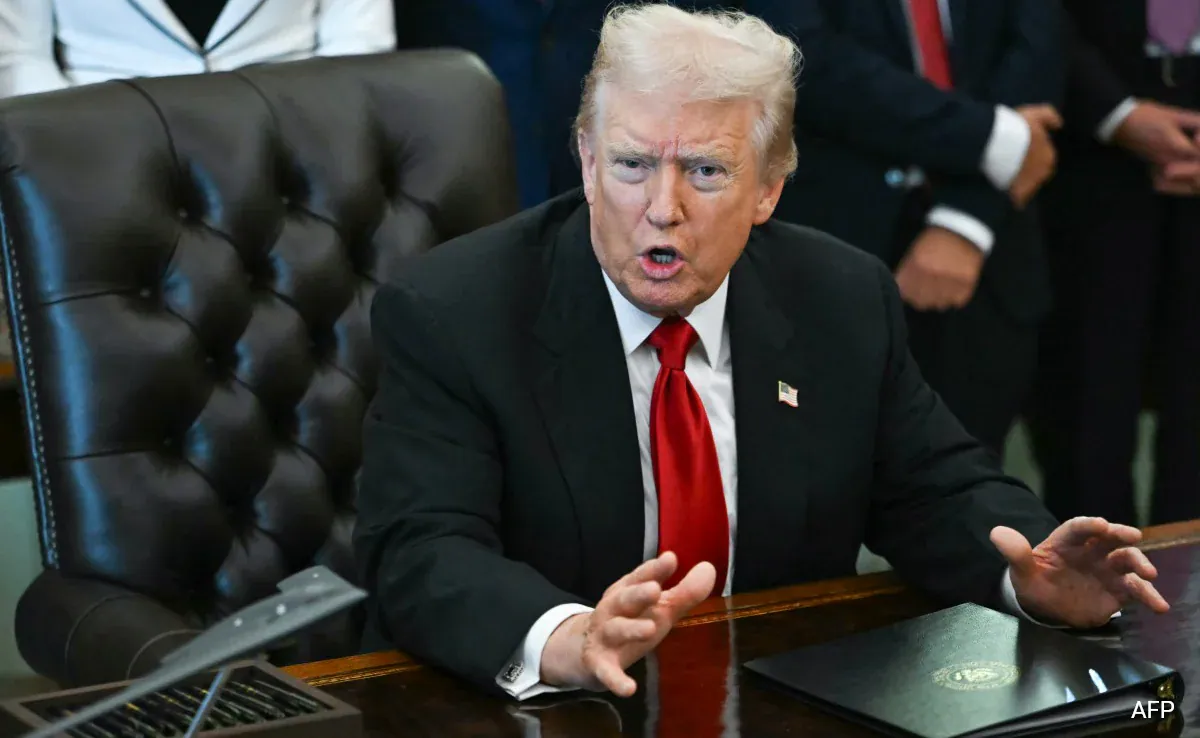
President Donald Trump has once again resurrected his proposal to distribute a $2,000 dividend to American citizens funded by revenue collected from his administration’s sweeping tariff regime. The promise, posted on Truth Social over the weekend, represents the latest iteration of an idea the president has repeatedly championed throughout 2025 but has yet to implement in any concrete form.
The timing of Trump’s renewed commitment to the tariff dividend is particularly significant, coming as his trade policies face their most consequential legal test before the Supreme Court. The nation’s highest court recently heard oral arguments examining whether the president possessed the constitutional authority to impose these duties, with several justices expressing notable skepticism about the legal foundation underlying the tariff structure.
Build the future you deserve. Get started with our top-tier Online courses: ACCA, HESI A2, ATI TEAS 7, HESI EXIT, NCLEX-RN, NCLEX-PN, and Financial Literacy. Let Serrari Ed guide your path to success. Enroll today.
The President’s Social Media Proclamation
In a series of posts on Truth Social on Sunday, Trump defended his tariff strategy with characteristic boldness. “We are taking in Trillions of Dollars and will soon begin paying down our ENORMOUS DEBT, $37 Trillion. Record Investment in the USA, plants and factories going up all over the place,” the president declared, framing his trade policies as both economically transformative and fiscally responsible.
The president went further, making a specific commitment that caught the attention of economists and policy analysts nationwide: “A dividend of at least $2000 a person (not including high income people!) will be paid to everyone.” This promise, while ambitious, lacks crucial details regarding implementation timelines, income thresholds for eligibility, and the legislative mechanism through which such payments would be authorized and distributed.
Supreme Court Scrutiny and Constitutional Questions
The legal challenges facing Trump’s tariff architecture have intensified significantly in recent weeks. During oral arguments before the Supreme Court, justices from across the ideological spectrum raised pointed questions about whether the executive branch overstepped its constitutional authority in implementing these trade duties without explicit congressional approval.
The central constitutional tension revolves around whether tariffs, when used primarily to generate revenue rather than address specific national security emergencies or trade imbalances, effectively function as taxes. Under the Constitution’s Origination Clause, all bills for raising revenue must originate in the House of Representatives, not through executive action.
Legal scholars monitoring the case have noted that the justices appeared particularly troubled by the administration’s broad interpretation of presidential authority under various trade statutes. The concern centers on whether accepting the government’s position would grant future presidents virtually unlimited power to impose taxes disguised as tariffs, fundamentally altering the constitutional balance of power between the executive and legislative branches.
Potential Financial Ramifications
The stakes in this Supreme Court case extend far beyond abstract constitutional principles. Legal and financial analysts estimate that if the high court rules against the administration, the federal government could face an obligation to refund more than $100 billion to importers who paid duties that are subsequently deemed illegal. Such a massive refund would represent one of the largest fiscal reversals in American history and could significantly complicate federal budget planning.
This potential financial exposure adds another layer of complexity to Trump’s dividend promise. If the tariffs are struck down, not only would the revenue stream for funding the proposed payments evaporate, but the government would simultaneously face unprecedented refund obligations that could strain the Treasury.
Treasury Secretary’s Defense
Treasury Secretary Scott Bessent attempted to reframe the narrative around the administration’s tariff strategy during an appearance on ABC’s “This Week” on Sunday. Bessent insisted that the tariffs were fundamentally “not about taking in the revenue,” but rather were designed as tools to “re-balance trade” relationships with key trading partners, particularly China and the European Union.
This characterization represents a delicate rhetorical dance for the administration. While emphasizing trade rebalancing might strengthen the legal argument that tariffs serve a legitimate policy purpose beyond revenue generation, it simultaneously undermines Trump’s repeated claims about the vast sums being collected and their potential use for debt reduction and dividend payments.
The apparent tension between the president’s revenue-focused messaging and his Treasury Secretary’s policy-focused explanation highlights the political and legal tightrope the administration walks as it defends its trade agenda on multiple fronts.
Political Fallout and Electoral Consequences
Trump’s renewed emphasis on tariff dividends comes against a backdrop of significant political turbulence for Republicans. Recent elections saw voters deliver punishing verdicts to GOP candidates in several key races, with exit polls and post-election analysis suggesting that inflation concerns played a decisive role in shaping electoral outcomes.
Economists have widely attributed at least a portion of the elevated price levels Americans experienced throughout 2025 to the cascading effects of Trump’s tariff policies. When tariffs increase the cost of imported goods and raw materials, those expenses typically flow through supply chains, ultimately manifesting as higher prices for consumers at retail stores and online marketplaces.
The political irony is stark: Trump implemented tariffs partly to demonstrate strength on trade and economic policy, yet the resulting price increases contributed to electoral defeats for his party. Now, facing both legal challenges and political backlash, the president has doubled down on promises to share tariff revenues with ordinary Americans—a move that could be interpreted as an acknowledgment that citizens deserve compensation for the higher costs they’ve absorbed.
One decision can change your entire career. Take that step with our Online courses in ACCA, HESI A2, ATI TEAS 7, HESI EXIT, NCLEX-RN, NCLEX-PN, and Financial Literacy. Join Serrari Ed and start building your brighter future today.
A History of Unfulfilled Promises
This is far from the first time President Trump has floated the concept of a tariff dividend. Throughout 2025, he has made numerous hints and suggestions about distributing tariff revenues directly to American citizens. However, these promises have consistently remained in the realm of political rhetoric rather than concrete policy proposals submitted to Congress for consideration and debate.
The president’s messaging on the specific amount of the proposed dividend has evolved over time. While earlier in the year he spoke in more general terms about sharing tariff wealth with Americans, he has recently coalesced around the specific figure of $2,000 per person. Notably, Trump has indicated that high-income individuals would be excluded from receiving payments, though he has not specified where that income threshold would be set or how the means-testing mechanism would function.
Policy experts have noted that actually implementing such a dividend program would require substantial administrative infrastructure and clear legislative authorization. The president cannot simply direct the Treasury to mail checks to citizens without congressional appropriation, regardless of how much revenue tariffs generate.
Economic Analysis and Feasibility Questions
Independent economic analysts have raised numerous questions about the feasibility and wisdom of Trump’s tariff dividend proposal. First, there are questions about the actual revenue figures. While Trump claims tariffs are bringing in “trillions of dollars,” official data from the Census Bureau and other government sources suggest more modest collection amounts, though still substantial.
Even if we accept optimistic revenue projections, distributing $2,000 to every American (excluding high earners) would require hundreds of billions of dollars. With approximately 260 million adults in the United States, and assuming roughly 80% would qualify under an income exclusion, a $2,000 dividend would cost over $400 billion annually. This sum would consume the vast majority of tariff revenues, leaving little for Trump’s stated goal of paying down the national debt.
Furthermore, economists warn that distributing large cash payments while simultaneously maintaining tariffs that increase prices could prove counterproductive. If the dividend simply offsets tariff-induced price increases without addressing the underlying inefficiencies in the economy, the policy would amount to an elaborate and economically distortionary wealth redistribution scheme rather than a genuine improvement in American prosperity.
International Trade Implications
Trump’s tariff policies and dividend promises don’t exist in a vacuum—they have significant implications for America’s relationships with trading partners worldwide. Major economies including China, the European Union, Canada, and Mexico have implemented or threatened retaliatory measures in response to American tariffs, potentially triggering a cycle of trade restrictions that could harm global economic growth.
International trade organizations and foreign government officials have expressed concern that using tariffs primarily as revenue-generation tools represents a departure from decades of multilateral trade agreements and frameworks. The World Trade Organization has mechanisms for adjudicating trade disputes, but Trump’s approach has often bypassed these traditional channels in favor of unilateral executive action.
What Happens Next
The Supreme Court’s decision on the tariff case will likely arrive sometime in the coming months, though the precise timing remains uncertain. If the justices uphold the president’s authority to impose these duties, Trump will face immediate pressure from supporters and critics alike to clarify the specifics of his dividend promise: Who exactly qualifies? When would payments begin? What legislative vehicle would authorize the distribution?
Conversely, if the Court strikes down the tariffs as unconstitutional overreach, the administration would need to fundamentally restructure its trade policy approach—potentially working with Congress to craft tariff legislation that passes constitutional muster while attempting to preserve the president’s core objectives on trade rebalancing.
For members of Congress, particularly Republicans who face challenging reelection campaigns in 2026, the tariff dividend proposal presents a complex political calculus. Supporting it could provide an opportunity to demonstrate responsiveness to constituent concerns about cost of living, but it would also require voting for what amounts to a massive spending program funded by duties that many economists criticize as economically harmful.
Broader Policy Context
Trump’s tariff dividend concept fits within a larger debate about industrial policy and economic nationalism that has gained traction across the political spectrum in recent years. Both Democratic and Republican policymakers have increasingly questioned the merits of unfettered free trade, particularly regarding China, and have explored various mechanisms to protect American industries and workers from foreign competition.
However, the specific approach of using tariffs as a primary revenue source to fund direct payments to citizens represents a novel and controversial twist on these themes. Traditional arguments for tariffs center on protecting domestic industries, encouraging reshoring of manufacturing, or responding to unfair trade practices by foreign governments. Using them explicitly as a taxation mechanism that funds a universal basic income-style payment program represents uncharted territory in American trade policy.
Conclusion
President Trump’s renewed promise of a $2,000 tariff dividend encapsulates many of the tensions and contradictions inherent in his administration’s approach to trade policy. The proposal appeals to populist instincts about sharing the benefits of tough trade stances with ordinary Americans, yet faces formidable legal, economic, and political obstacles to implementation.
As the Supreme Court deliberates on the constitutional foundations of the tariff regime, and as voters continue to grapple with the economic consequences of these policies, Trump’s dividend promise serves as both a political lifeline and a potential millstone. Whether it represents a genuine policy commitment or merely aspirational political messaging will likely become clearer in the months ahead as legal proceedings conclude and legislative battles over trade and fiscal policy intensify.
What remains certain is that the intersection of tariffs, constitutional law, electoral politics, and economic policy will continue to generate intense debate and scrutiny as America navigates an increasingly complex global economic landscape.
Ready to take your career to the next level? Join our Online courses: ACCA, HESI A2, ATI TEAS 7 , HESI EXIT , NCLEX – RN and NCLEX – PN, Financial Literacy!🌟 Dive into a world of opportunities and empower yourself for success. Explore more at Serrari Ed and start your exciting journey today! ✨
Track GDP, Inflation and Central Bank rates for top African markets with Serrari’s comparator tool.
See today’s Treasury bonds and Money market funds movement across financial service providers in Kenya, using Serrari’s comparator tools.
photo source: Google
By: Montel Kamau
Serrari Financial Analyst
10th November, 2025