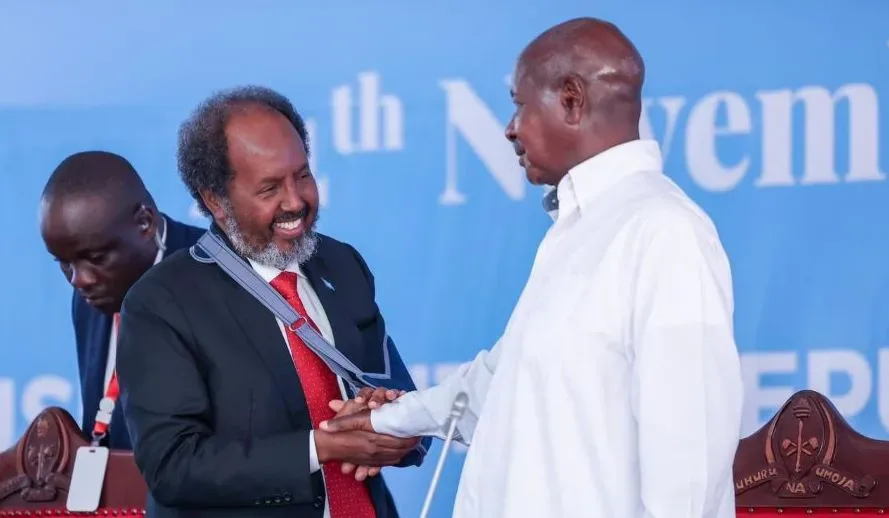
Somalia has successfully secured its place as the eighth member of the East African Community (EAC), signifying a significant advancement in the push for expanded free trade across the region. The announcement came at a summit in Tanzania, where outgoing EAC Chair Evariste Ndayishimiye confirmed Somalia’s admission under the treaty of accession.
President Hassan Sheikh Mohamud, Somalia’s representative at the summit, expressed optimism for the future, emphasizing the historical significance of this moment. His chief economic adviser conveyed these sentiments on the digital platform X (formerly known as Twitter), describing it as “a beacon of hope for a future full of possibilities and opportunities.”
Established in 2000, the EAC, headquartered in Arusha, Tanzania, aims to boost trade by removing customs duties among member states. The formation of a common market in 2010 paved the way for increased collaboration. Excluding Somalia, the combined EAC countries covered a vast land area of 4.8 million square kilometers, boasting a collective GDP of $305 billion. The total EAC trade reached $78.75 billion in 2022, according to official records.
Somalia’s inclusion in the EAC follows the admission of the Democratic Republic of Congo in April 2022. However, the move is not without challenges. Somalia’s ongoing struggle against the al-Qaeda-linked al-Shabab group poses potential security risks for the bloc. Despite significant progress, concerns linger regarding the government’s capacity to quell the 16-year rebellion, leading to a potential impact on regional stability.
Both Kenya and Uganda, existing EAC members, actively contribute troops to an African Union force deployed in Somalia since 2007, primarily aimed at combating al-Shabab. Additionally, the EAC recently deployed troops to the Democratic Republic of Congo in response to the resurgence of the M23 rebel group.
The Mogadishu-based Heritage Institute for Policy Studies views Somalia’s entry into the EAC as a “pivotal leap” in the bloc’s expansion across East Africa. However, the institute cautions against potential challenges arising from Somalia’s “poor track record in governance, human rights, and the rule of law,” which could impact its seamless integration. Historical disputes with neighboring countries, including Ethiopia, Djibouti, and Kenya, add a layer of complexity to Somalia’s diplomatic relations.
As Somalia takes this transformative step towards economic integration, the region watches with a balanced perspective, acknowledging the historic achievement while recognizing the hurdles that lie ahead.
Photo (Charles Dietz)
By: Montel Kamau
Serrari Financial Analyst
27th November, 2023