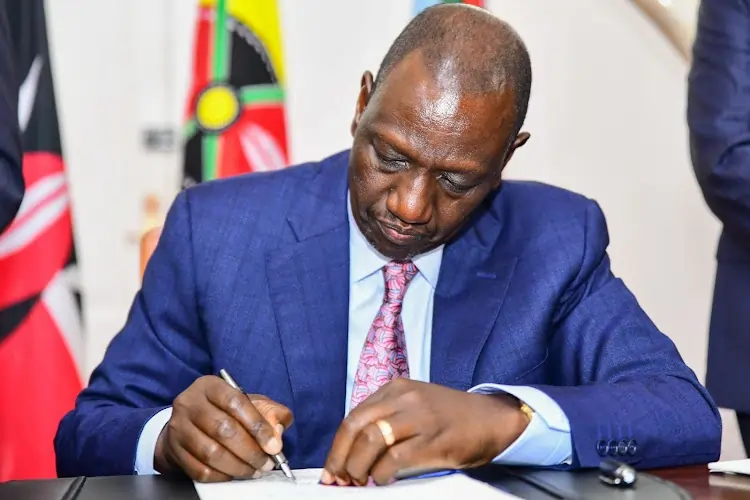
In a significant move aimed at addressing Kenya’s economic challenges, President William Ruto has officially signed the Supplementary Appropriations Act. This new piece of legislation marks a crucial step in the government’s effort to implement austerity measures, reflecting a broader strategy to tackle the country’s budgetary constraints and economic issues.
Background: The Need for Austerity
Kenya’s economic landscape has been increasingly strained by a series of fiscal pressures and budgetary shortfalls. The country faces a significant revenue shortfall estimated at Kshs. 344.3 billion, prompting the government to introduce a series of austerity measures. The Supplementary Appropriations Act is a key component of this strategy, aimed at realigning the national budget and addressing fiscal imbalances.
Key Reductions in the Supplementary Appropriations Act
The Act introduces substantial cuts across various sectors, reflecting the government’s commitment to reducing expenditures. Notable reductions include:
- Presidency: A cut of Kshs. 6 billion.
- Medical Services: A reduction of Kshs. 6.9 billion.
- Roads and Transport Projects: A significant cut of Kshs. 17.3 billion.
These reductions are part of a broader strategy to streamline government spending and reallocate resources to more critical areas. The cuts, while aimed at reducing the budget deficit, have sparked concerns about their potential impact on essential services and infrastructure.
Balancing Austerity and Social Impact
A brief forwarded to President Ruto by parliament emphasized the delicate balance required between implementing necessary austerity measures and protecting the livelihoods of Kenyans. The brief outlined the government’s challenge in reducing expenditures while ensuring that critical services and economic stability are not compromised.
“While it could be prudent to reduce expenditures by the amount equivalent to the anticipated revenue shortfall of Kshs. 344.3 billion, this was not tenable given the delicate balance between austerity measures and cushioning the livelihoods of the people and the economy,” the brief stated.
This statement reflects the government’s awareness of the potential social impact of the budget cuts and its commitment to mitigating adverse effects on the population.
The Withdrawal of the Finance Bill 2024
The signing of the Supplementary Appropriations Act comes on the heels of President Ruto’s unprecedented decision on June 26 to withdraw the controversial Finance Bill 2024. This move was a direct response to widespread public dissent and protests, particularly from younger generations who were vocal about their opposition to the bill.
In a historic moment for Kenyan politics, President Ruto declared, “Listening keenly to the people of Kenya, who have said loudly that they want nothing to do with this Finance Bill 2024, I concede and therefore I will not sign the 2024 Finance Bill, and it shall subsequently be withdrawn.”
This decision marked the first time since Kenya’s independence that a Finance Bill was withdrawn under such circumstances, highlighting the significant influence of public opinion and the power of civil society in shaping governmental decisions.
Managing the Budget Deficit
With the Finance Bill 2024 withdrawn, the government will now rely on the existing Finance Act to manage the Sh3.9 trillion budget. The Supplementary Appropriations Act will be complemented by both external and internal borrowing to address the budget deficit and ensure the continuity of essential services and projects.
The government’s approach to managing the budget deficit involves a combination of spending cuts, borrowing, and potential revenue-enhancing measures. This multifaceted strategy aims to stabilize Kenya’s fiscal situation while minimizing disruption to public services and infrastructure.
Public Reaction and Future Implications
The public’s reaction to the austerity measures and the withdrawal of the Finance Bill has been mixed. While some view the measures as necessary steps towards fiscal responsibility, others express concern about the potential impact on essential services and infrastructure projects.
The significant cuts in medical services and transportation are particularly contentious, with critics arguing that they could undermine the quality of public health services and infrastructure development. Additionally, the reduction in funding for these critical areas may affect the government’s ability to deliver on key developmental goals.
Looking Ahead: Economic and Political Landscape
As Kenya navigates these challenging times, the government’s ability to balance fiscal prudence with social responsibility will be closely watched. The implementation of the Supplementary Appropriations Act and the management of the budget deficit will be critical in shaping Kenya’s economic and political landscape in the coming months.
The withdrawal of the Finance Bill 2024 and the signing of the Supplementary Appropriations Act reflect a significant shift in Kenya’s approach to economic management. President Ruto’s decisions highlight the complexities of governing in a context of economic strain and public pressure, underscoring the need for effective and responsive governance.
In summary, the signing of the Supplementary Appropriations Act marks a pivotal moment in Kenya’s efforts to address its budgetary challenges. The government’s actions reflect a delicate balancing act between implementing necessary austerity measures and ensuring that essential services and infrastructure are not unduly compromised. As Kenya moves forward, the effectiveness of these measures and their impact on the country’s economic stability and public services will be closely scrutinized.
photo source: Google
By: Montel Kamau
Serrari Financial Analyst
6th August, 2024