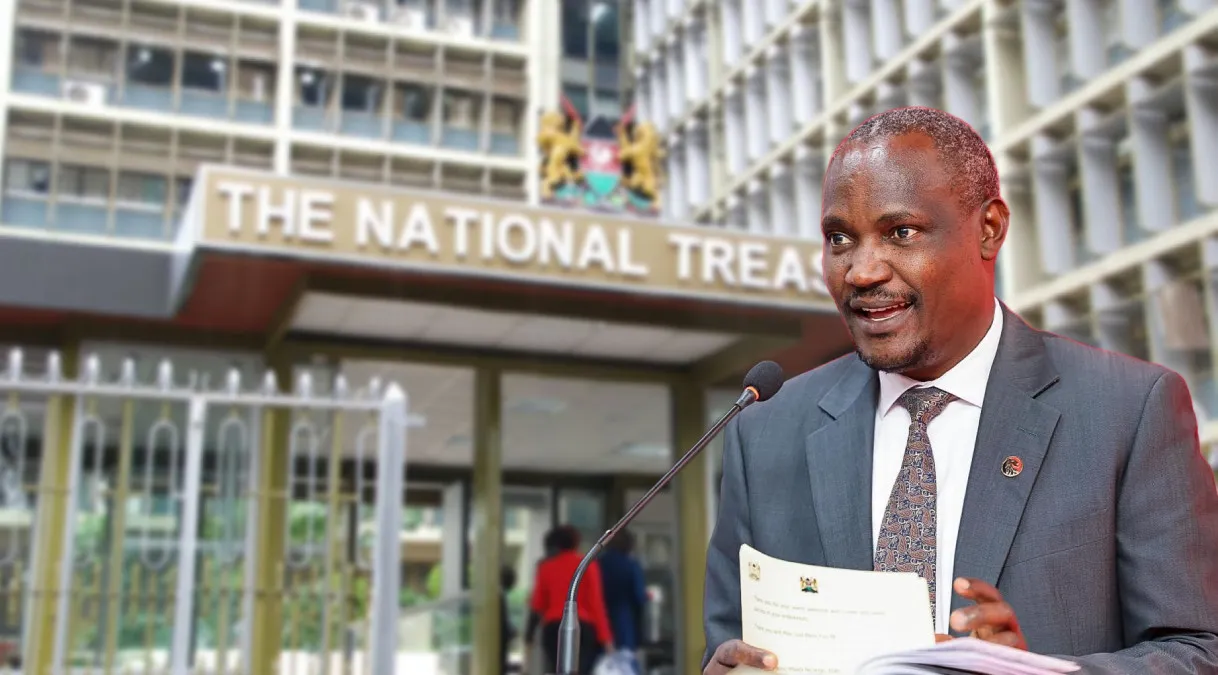
Kenya’s government is preparing for a significant recalibration of its debt-financing strategy, with domestic borrowing set to take centre stage in funding the budget deficit over the medium term. The shift, outlined in the National Treasury of Kenya’s draft Medium Term Debt Strategy (MTDS) for 2026, reflects a deliberate effort to rein in borrowing costs, reduce foreign exchange exposure, and manage growing debt vulnerabilities.
According to the draft strategy, 82% of the government’s gross borrowing requirements will be sourced from the domestic market, with external financing accounting for just 18%. Over the 2026/27 to 2028/29 fiscal period, the projected net borrowing mix is slightly more balanced but still heavily tilted toward local sources, at 78% domestic and 22% external.
This marks one of the clearest policy signals yet that Kenya intends to rely primarily on its domestic capital market to finance fiscal deficits—an approach shaped as much by necessity as by strategic intent.
Build the future you deserve. Get started with our top-tier Online courses: ACCA, HESI A2, ATI TEAS 7, HESI EXIT, NCLEX-RN, NCLEX-PN, and Financial Literacy. Let Serrari Ed guide your path to success. Enroll today.
The Rationale Behind the Pivot
In the draft MTDS, the Treasury explains that the preferred approach—labelled Strategy 2—seeks to strike a balance between cost, risk, and market development.
“From an array of strategies analysed, Strategy 2 proposes balancing lower-cost external borrowing with deepening the domestic debt market, locking in fixed rates and lowering foreign exchange rate exposure,” the Treasury said.
At its core, the strategy aims to address two persistent challenges in Kenya’s public finances:
- Exposure to foreign exchange risk, which amplifies debt-servicing costs when the shilling weakens.
- Volatility and uncertainty in external financing, including delays in disbursements from multilateral lenders and constrained access to international capital markets.
By leaning more heavily on domestic borrowing—particularly fixed-rate Treasury bonds—the government hopes to gain greater predictability over debt servicing costs and reduce vulnerability to global financial shocks.
A Pattern of Missed Targets
While the MTDS lays out ambitious targets for managing the domestic–external borrowing mix, Kenya’s recent fiscal history suggests that execution has often diverged sharply from planning.
In the 2024/25 fiscal year, the government sourced 83% of its revenue needs locally, far exceeding the 55% target set at the start of the year. Similar deviations have been recorded repeatedly:
- June 2024: Domestic borrowing exceeded targets by 23 percentage points
- June 2023: Exceeded by 3 percentage points
- June 2022: Exceeded by 12 percentage points
- June 2021: Exceeded by 9 percentage points
These deviations were not driven by preference alone. The Treasury has repeatedly pointed to delays and shortfalls in external financing as the primary cause of overreliance on domestic markets.
When Plans Meet Reality: The 2024/25 Case Study
The divergence between planned and actual borrowing was particularly stark in 2024/25. The MTDS initially envisaged that 55% of net deficit financing would come from domestic sources, with 45% from external borrowing.
In practice, however, the financing mix shifted dramatically:
- 83% net domestic financing
- 17% net external financing
This outcome underscored the fragility of Kenya’s external funding pipeline. Delays in multilateral loans, cautious bilateral lenders, and limited access to Eurobond markets left the government with few alternatives but to turn to local investors.
One decision can change your entire career. Take that step with our Online courses in ACCA, HESI A2, ATI TEAS 7, HESI EXIT, NCLEX-RN, NCLEX-PN, and Financial Literacy. Join Serrari Ed and start building your brighter future today.
The Domestic Market: Strength and Strain
Kenya’s domestic debt market is among the deepest in sub-Saharan Africa, anchored by a well-established Treasury bills and bonds programme, active commercial banks, pension funds, and a growing base of institutional investors.
However, sustained reliance on the local market carries its own risks.
Rising Refinancing Pressure
One of the clearest warning signs is the deterioration in domestic debt risk indicators. In the year ending June 2025, the proportion of domestic debt instruments with less than one year to maturity rose to 20.5%, up from 18.6% a year earlier.
This shift toward shorter maturities increases refinancing risk, exposing the government to rollover pressure and interest-rate fluctuations.
Crowding Out the Private Sector
Heavy government borrowing can absorb liquidity that would otherwise be available to businesses and households. Commercial banks, attracted by risk-free government securities, may reduce lending to the private sector, constraining economic growth.
Why External Borrowing Has Become Harder
Kenya’s reduced reliance on external financing is not occurring in a vacuum. Several structural and cyclical factors have made foreign borrowing more challenging:
- Tighter global financial conditions, with higher interest rates in advanced economies
- Increased scrutiny from lenders over debt sustainability
- Currency risk, which raises the cost of servicing foreign-denominated debt
- Market fatigue following years of heavy Eurobond issuance across emerging markets
While external loans often carry lower nominal interest rates, they expose the budget to exchange-rate swings—an increasingly costly trade-off in recent years.
Deepening the Domestic Market: Opportunity and Obligation
One of the Treasury’s stated goals is to deepen the domestic debt market. In theory, this offers several benefits:
- Reduced dependence on volatile external flows
- Development of long-term yield curves
- Stronger domestic savings mobilisation
- Greater monetary policy transmission
In practice, achieving these benefits requires careful calibration. Excessive issuance, especially at the short end, can undermine market stability and push yields higher.
Historical Context: Kenya’s Debt Evolution
Kenya’s public debt profile has evolved significantly over the past two decades. In the early 2000s, the country relied heavily on concessional external loans. Over time, domestic borrowing grew as financial markets deepened and government financing needs expanded.
The past decade marked a turning point, with large-scale external borrowing—including Eurobonds—used to finance infrastructure and budget deficits. As global conditions tightened and debt-servicing costs rose, the pendulum has swung back toward domestic financing.
The current MTDS reflects this long arc, attempting to balance lessons learned from both extremes.
Why This Matters: Beyond the Numbers
The implications of the government’s borrowing strategy extend far beyond fiscal spreadsheets.
1. Budget Sustainability
Interest payments already consume a significant share of government revenue. Locking in high domestic yields today can constrain future budgets, reducing space for social spending and development.
2. Financial System Stability
Banks and pension funds hold large amounts of government paper. A mismanaged borrowing strategy could create systemic risks if refinancing pressures intensify.
3. Economic Growth
Crowding out private investment undermines job creation and productivity—key drivers of long-term growth.
4. Policy Credibility
Repeated deviations from stated targets weaken confidence in fiscal planning, making markets more cautious and potentially more expensive to access.
The Balancing Act Ahead
The Treasury’s challenge is not choosing between domestic and external borrowing—but managing both in a way that minimizes risk while meeting financing needs.
Success will depend on:
- Predictable issuance calendars
- Gradual extension of maturities
- Transparent communication with markets
- Improved coordination with development partners
Crucially, it will also require addressing the root causes of fiscal pressure, including revenue shortfalls and expenditure rigidities.
Looking Ahead: Will Strategy Match Execution?
The draft MTDS sets out a clear vision, but Kenya’s track record shows that implementation often falters under real-world constraints.
If external financing improves, the domestic burden may ease. If not, domestic markets will continue to shoulder the load—with rising implications for interest costs and market liquidity.
Investors, analysts, and policymakers will be watching closely to see whether the 2026–2029 period marks a turning point in fiscal discipline or a continuation of reactive borrowing patterns.
Conclusion: A Necessary Shift with Real Trade-Offs
Kenya’s decision to lean heavily on domestic borrowing reflects both pragmatism and constraint. In an environment of tight global capital and heightened debt scrutiny, the local market offers certainty and control.
But certainty comes at a price. Without careful management, the strategy risks higher long-term costs, increased refinancing pressure, and slower economic growth.
The 2026 MTDS acknowledges these risks. Whether policy execution can match intent will determine whether domestic borrowing becomes a stabilising anchor—or a new source of vulnerability—in Kenya’s public finance story.
Ready to take your career to the next level? Join our Online courses: ACCA, HESI A2, ATI TEAS 7 , HESI EXIT , NCLEX – RN and NCLEX – PN, Financial Literacy!🌟 Dive into a world of opportunities and empower yourself for success. Explore more at Serrari Ed and start your exciting journey today! ✨
photo source: Google
By : Elsie Njenga
3rd February, 2026