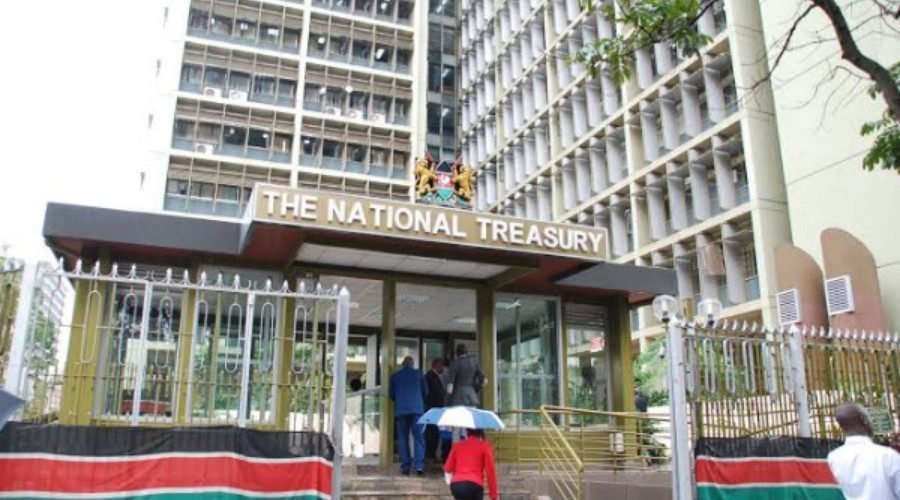
In a strategic move to address potential challenges in its foreign exchange reserves, Kenya’s National Treasury has appointed Citi and Standard Bank as joint lead managers. Their mandate is to explore options for international US$ capital markets funding and liability management for Kenya.
With the looming pressure on foreign exchange reserves in 2024 due to the absence of a new Eurobond, Kenya is set to repay $300 million of a $2 billion Eurobond scheduled for June 2024. The country aims to navigate this financial hurdle, easing external debt pressures by utilizing increased concessional borrowing. A respite is anticipated with a three-year pause until the next cycle of Eurobond maturities in 2027 and 2028.
The proceeds from this financial maneuver are earmarked to support the 2023/24 budget. However, the National Treasury warns that any transaction will be contingent on prevailing market conditions.
Kenya’s handling of Eurobond maturity repayments has garnered attention as the country grapples with high debt distress levels, a depreciating Kenyan Shilling against the US Dollar, and a surge in yields that has restricted access to international capital markets for many frontier countries.
Once attracted by competitive financing terms in the Eurobond market, including coupon rates in the 6.5 – 8.5 percent range, Kenya now faces changed market conditions. The country’s total external debt has surged from US$ 10.2 billion in 2013 to US$ 34.8 billion in 2020, according to the Central Bank of Kenya (CBK). Commercial borrowing increased tenfold to US$ 10.4 billion, while bilateral loans rose nearly fourfold to US$ 10.6 billion, primarily led by China.
To cope with the rising debt burden, Kenya shifted its borrowing dynamics between 2020 and 2022, turning to concessional multilateral borrowing from the IMF, the World Bank, and the African Development Bank (AfDB). A 38-month IMF program, initiated in April 2021 and running until mid-2024, with a US$ 2.34 billion funding envelope, aimed at strengthening fiscal and debt management.
Despite these efforts, a planned sale of a US$ 982 million Eurobond in January 2022 was abandoned in June 2022 due to escalating yields on existing Eurobonds, rendering the new issue financially unviable.
The repercussions of the canceled Eurobond issue have been evident in a gradual erosion of Kenya’s foreign exchange reserves. From US$ 8.3 billion in January 2022 (equivalent to 5.1 months of import cover), the reserves dwindled to US$ 7.0 billion in November 2023 (4.0 months of import cover). As of September 22, 2023, the foreign exchange reserves stand at USD 7.0 billion, representing 3.8 months of import cover. The latest CBK weekly statistical bulletin, dated November 9th, 2023, reports foreign exchange reserves at USD 6.8 billion (3.7 months of import cover).
Internationally, yields on Kenya’s Eurobonds have surged, with an average increase of 14.17 basis points. Notably, the 2024 maturity has witnessed a substantial spike of 137.9 basis points.
Kenya’s financial strategy, as facilitated by Citi and Standard Bank, will be closely observed as the country navigates the complexities of international capital markets and seeks to address its debt challenges.
Photo (The National Treasury and Economic Planning)
By Delino Gayweh
Serrari Financial Analyst
15th November, 2023