

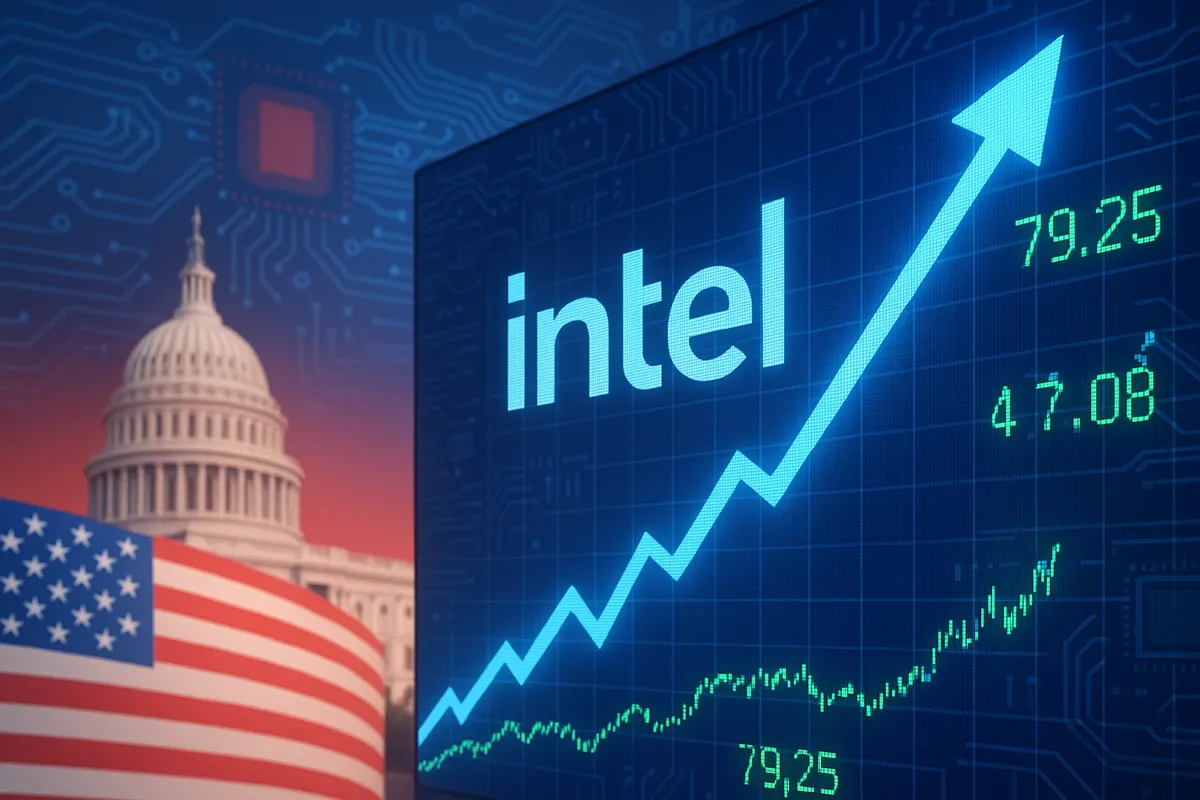
Shares in tech giant Intel Corp. skyrocketed on Thursday, jumping by more than 7% in a single day of trading, following a bombshell report from Bloomberg. The report revealed that the Trump administration is in deep discussions about the possibility of the U.S. government taking a direct stake in the struggling chipmaker.
The news, which sent ripples through global markets, positions a government-backed deal as a potential “lifeline” for Intel, a storied company that has seen its fortunes wane in recent years. The reported deal is intrinsically linked to Intel’s ambitious plan to build a massive chip manufacturing hub in Ohio, a project that has faced numerous delays and significant financial challenges.
Build the future you deserve. Get started with our top-tier Online courses: ACCA, HESI A2, ATI TEAS 7, HESI EXIT, NCLEX-RN, NCLEX-PN, and Financial Literacy. Let Serrari Ed guide your path to success. Enroll today.
While details remain fluid and neither the White House nor Intel has offered official confirmation, a spokesperson for the Trump administration, Kush Desai, stated that “discussion about hypothetical deals should be regarded as speculation unless officially announced by the administration.” This carefully worded statement did little to dampen the enthusiasm on Wall Street. Similarly, a spokesperson for Intel declined to comment on the specific discussions but reiterated the company’s commitment to “supporting President Trump’s efforts to strengthen U.S. technology and manufacturing leadership.”
This dramatic turn of events follows a period of intense public scrutiny for Intel, particularly its new chief executive, Lip-Bu Tan. Just days before the deal became public, President Donald Trump had used his social media platform to call for Tan’s resignation, accusing him of being “highly conflicted” due to alleged ties to China. The public spat between the U.S. president and the CEO of a cornerstone American tech company underscores the profound geopolitical tensions that are increasingly shaping the global business landscape.
A Fallen Giant: How Intel Lost Its Crown
To understand the strategic importance of this potential government intervention, one must first grasp the depth of Intel’s recent struggles. Once the undisputed titan of the semiconductor industry, Intel has fallen dramatically from grace. Its market value, which once surpassed that of many of its peers, has more than halved to $104 billion (£77bn) since 2020. This decline is not a simple matter of market fluctuation; it is the result of years of manufacturing missteps, strategic blunders, and an inability to adapt to a rapidly changing technological landscape.
The primary factor in Intel’s decline has been its failure to keep pace with the rest of the industry in the “AI race.” While its traditional business of making Central Processing Units (CPUs) for PCs and servers remains a massive market, the future of computing is increasingly driven by Artificial Intelligence (AI). AI models require specialized chips called GPUs (Graphics Processing Units) for “training” and “inference,” a market almost entirely dominated by its fierce rival, Nvidia. Nvidia’s success with its CUDA software platform has created a powerful ecosystem that makes it incredibly difficult for competitors to break in. Intel’s own efforts to compete with its Gaudi AI chips have struggled to gain significant market traction. The company’s CEO, Lip-Bu Tan, recently made a jarring admission, suggesting in a leaked internal discussion that it may already be “too late” for Intel to catch up in the AI training hardware space.
Compounding this strategic failure is a series of well-documented manufacturing delays. For years, Intel struggled to transition to its next-generation 7-nanometer (7nm) process technology, while rivals like AMD leveraged external foundries like Taiwan Semiconductor Manufacturing Co. (TSMC) to produce smaller, more efficient chips. This left Intel playing catch-up, and its CPUs began to lose their performance edge. The company’s once-unimaginable reliance on TSMC for parts of its own chips is a clear indicator of how far it has fallen. Intel is reportedly struggling with the yields on its new “Panther Lake” processors, a critical hurdle that could force it to sell chips at a loss to maintain market share.
The Ohio Project: A Bet on the Future of American Manufacturing
At the heart of the reported government stake is Intel’s massive planned manufacturing hub in Ohio. Dubbed the “Silicon Heartland,” this project represents a critical part of the company’s plan to regain its manufacturing edge and become a major player in the global foundry business—making chips for other companies, not just for itself.
The project, which was initially announced in January 2022, represents a planned investment of over $20 billion, later increased to $28 billion. The site, spanning nearly 1,000 acres outside of Columbus, Ohio, has the potential to become one of the world’s largest semiconductor manufacturing facilities, with space for up to eight fabrication plants (or “fabs”). The project promised to create 3,000 Intel jobs, 7,000 construction jobs, and tens of thousands of indirect roles across the region. It’s a key part of Intel’s IDM 2.0 strategy, a vision to rebuild its manufacturing prowess and secure its position as a domestic supplier of cutting-edge semiconductors.
However, the path to building the Ohio factory has been rocky. It has faced numerous delays and is a capital-intensive undertaking at a time when Intel’s finances are under immense pressure. The reported government stake would likely be a direct lifeline, providing the necessary funding and support to push the project forward. This support would not only benefit Intel but also align with a broader U.S. government initiative to secure the domestic semiconductor supply chain.
Fuel your success with knowledge that matters. Enroll in our Online programs: ACCA, HESI A2, ATI TEAS 7, HESI EXIT, NCLEX-RN, NCLEX-PN, and Financial Literacy. Join Serrari Ed now and take control of your future.
The New Industrial Policy: A Deeper Intertwining of State and Industry
The potential deal with Intel signals a significant shift in U.S. economic policy—a deeper “intertwining” of the government and private business. This move mirrors a trend that has been seen for years in places like China, where the government plays a direct role in steering strategic industries. For the United States, which has traditionally championed free markets and limited government intervention, this represents a new form of industrial policy.
The context for this shift is the escalating geopolitical “chip war” with China. Semiconductors are not just an economic commodity; they are the bedrock of modern technology, underpinning everything from military hardware and AI systems to smartphones and autonomous vehicles. The U.S. government has grown increasingly concerned about its reliance on foreign chip manufacturers, particularly TSMC in Taiwan, a region of high geopolitical risk.
This new policy is already visible in other areas. This week, for example, the Trump administration announced an unprecedented deal with chip giants Nvidia and AMD, requiring them to pay the U.S. government 15% of their revenues from advanced chips sold to China. This arrangement, which allows the companies to sell “fourth-best” chips like Nvidia’s H20 and AMD’s MI308 to the massive Chinese market, is a powerful example of direct government intervention in private enterprise. While some critics argue that such a deal is unfair or even unconstitutional, a broad consensus in Washington believes that ensuring the U.S. has a secure and domestic supply of advanced chips is a matter of national security.
The legal and ethical implications of this new approach are still being debated. The deal with Nvidia and AMD has raised questions about whether the government is imposing an “export tax” on private companies, a practice that is constitutionally forbidden. Regardless of these debates, the trend is clear: the U.S. government is willing to use its power to influence market outcomes in strategically vital industries.
The CEO Under Fire: Lip-Bu Tan’s Complex History
The final piece of this complex puzzle is Intel’s new CEO, Lip-Bu Tan. A Malaysian-born American venture capitalist, Tan took the helm in March with the unenviable task of turning Intel around. His appointment was a signal to the market that the company was serious about a new direction.
However, his past has become a major point of contention for the Trump administration. President Trump’s demand for Tan’s resignation was based on allegations that Tan had invested in “hundreds” of Chinese companies, some of which reportedly have ties to the Chinese military. Senator Tom Cotton, a prominent critic of China, sent a letter to Intel’s board detailing these alleged connections. The accusations suggest that during his time as a venture capitalist, Tan’s investments in Chinese tech and manufacturing firms have created a potential conflict of interest that could compromise U.S. national security.
In a defiant internal memo to employees, Tan defended his past actions, stating that he has “always operated within the highest legal and ethical standards.” He also noted that he is “engaging with the Administration to address the matters that have been raised and ensure they have the facts.” The controversy highlights the extreme sensitivity around tech executives with ties to China, as they become targets in the broader geopolitical rivalry.
Ultimately, the political heat on Tan and the company itself may have accelerated the discussions for a government stake. For the Trump administration, it offers a way to secure a critical national asset and bolster domestic manufacturing, a key policy goal. For Intel, it provides the financial stability and political backing necessary to execute its ambitious turnaround strategy.
A High-Stakes Gamble
The potential government stake in Intel is a high-stakes gamble for all involved. For Intel, it represents a chance to stop its freefall and invest in a future of domestic manufacturing. For the U.S. government, it is a direct and forceful move to secure its technological leadership and reduce its reliance on foreign supply chains. For the global market, it signals a new era of industrial policy, where governments are no longer passive observers but active participants in the business of technology.
While the details of the deal are still being ironed out, one thing is certain: this is not just a business story. It is a story about the intersection of technology, economics, and national security in a world where the lines between the public and private sectors are blurring more than ever before. It’s a story of a storied American company fighting for its future, with the help of the very government that has also been its biggest critic.
The coming months will reveal the full scope of this unprecedented deal and whether this government lifeline will be enough to propel Intel back to the forefront of the chipmaking world.
Ready to take your career to the next level? Join our Online courses: ACCA, HESI A2, ATI TEAS 7 , HESI EXIT , NCLEX – RN and NCLEX – PN, Financial Literacy!🌟 Dive into a world of opportunities and empower yourself for success. Explore more at Serrari Ed and start your exciting journey today! ✨
Track GDP, Inflation and Central Bank rates for top African markets with Serrari’s comparator tool.
See today’s Treasury bonds and Money market funds movement across financial service providers in Kenya, using Serrari’s comparator tools.
Photo source: Google
By: Montel Kamau
Serrari Financial Analyst
15th August, 2025