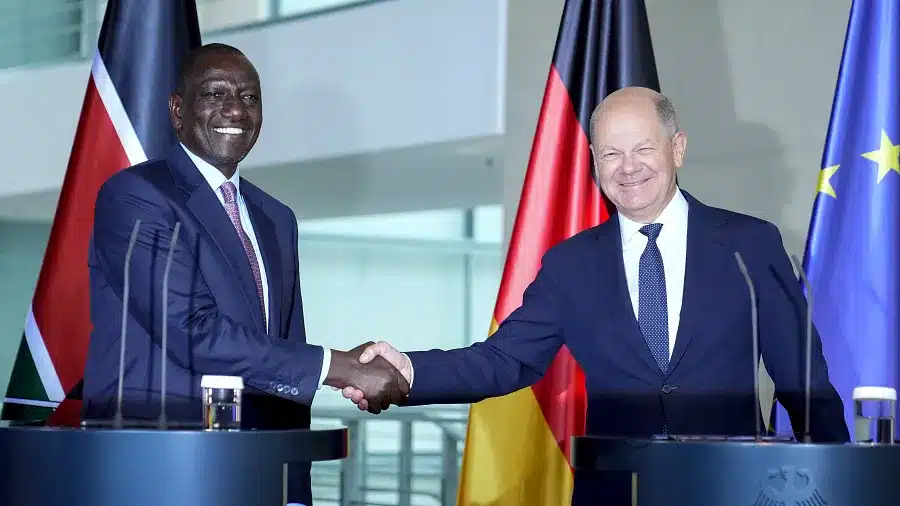
In a significant move to address labor shortages, Germany and Kenya signed a bilateral agreement on Friday, September 13, 2024, aimed at promoting the recruitment of skilled Kenyan workers to fill gaps in Germany’s labor market. The deal was signed in Berlin during a meeting between Kenyan President William Ruto and German Chancellor Olaf Scholz. The agreement also outlines procedures for the repatriation of Kenyans who do not have legal residency in Germany.
This partnership marks a deepening of diplomatic and economic ties between Germany and Kenya, a relationship increasingly important as both countries face domestic challenges and seek to boost their respective economies. Germany’s need for skilled labor, particularly in sectors such as information technology, healthcare, and engineering, is driving the urgency behind these efforts.
The Pressing Issue of Germany’s Labor Shortage
Germany, the largest economy in Europe, has been grappling with an aging population and a declining workforce. Experts estimate that the country needs approximately 400,000 skilled immigrants annually to maintain its economic stability. The shortage is particularly acute in fields like IT, healthcare, and engineering, where the demand for skilled professionals far exceeds the supply.
The agreement with Kenya is one of several such deals Germany has pursued in recent years to attract skilled workers from outside the European Union. In addition to Kenya, Germany has signed similar agreements with countries like India, Georgia, and Morocco. This weekend, Chancellor Scholz is expected to finalize another agreement with Uzbekistan during his visit there.
At a press conference after the signing ceremony, Scholz emphasized the importance of the agreement in helping Germany mitigate the long-term effects of its labor shortage. “This can help us to compensate for a shortage of skilled workers,” Scholz said, adding that this challenge is one that Germany “will be with us for years and decades to come.”
The new agreement is seen as part of a broader strategy by Germany to diversify its labor pool and reduce dependence on internal EU migration. With a shrinking workforce due to an aging population, Germany’s economic engine relies on attracting skilled workers from outside Europe to maintain its global competitiveness.
Kenya’s Advantage: A Young and Educated Workforce
For Kenya, the agreement presents a significant opportunity to leverage its youthful and educated population. Kenya boasts a median age of around 20, one of the youngest in the world, and has made substantial investments in education, particularly in the fields of science, technology, engineering, and mathematics (STEM). Kenyan President William Ruto noted that the partnership would be mutually beneficial, bringing together the technological prowess and resources of Germany with the youthful potential of Kenya.
Ruto assured that the migration of skilled workers to Germany would not harm Kenya’s economic development. “We have enough young people to support the development of both Kenya and Germany,” he said, highlighting that Kenya’s workforce is large enough to meet the demands of both countries.
The Kenyan IT sector, in particular, is seen as a key beneficiary of this agreement. With Nairobi often referred to as the “Silicon Savannah” due to its burgeoning tech scene, the country is home to a growing number of highly skilled IT professionals. The agreement provides a pathway for these professionals to take advantage of job opportunities in Germany while contributing to knowledge transfer between the two nations.
Addressing the Migration Challenge
In addition to facilitating the legal migration of skilled workers, the agreement also addresses the issue of repatriation for those Kenyans who do not have legal residency status in Germany. Chancellor Scholz stressed that the deal would ensure “effective return procedures” for Kenyans who do not have the right to remain in Germany. “They can now return home more easily and quickly,” Scholz said, pointing out that this part of the agreement is crucial in maintaining a balanced migration framework.
The migration issue has become a politically sensitive topic in Germany, with the rise of the far-right, anti-immigration party, Alternative for Germany (AfD). The AfD performed well in two recent state elections in eastern Germany and continues to challenge Scholz’s coalition government, particularly on immigration policies. Another state election in Brandenburg, which surrounds Berlin, is scheduled for September 22, further raising the stakes for the government.
Despite the political challenges, Scholz’s government has maintained that the country’s economic needs outweigh the pressures to limit immigration. Germany’s Interior Minister Nancy Faeser, who signed the agreement on behalf of Germany, stated that a carefully managed immigration system is vital for the country’s economic future. She noted that the government is committed to ensuring that the recruitment of foreign workers is done transparently and that the rights of both the host country and the migrant workers are protected.
A Broader Context: Germany’s Migration Policy Reforms
Germany’s move to recruit skilled workers from Kenya is part of a larger reform of its migration policy. Over the past few years, the German government has introduced a series of measures aimed at simplifying the immigration process for skilled workers. In March 2023, the German parliament passed a new immigration law that streamlined the process for non-EU workers to obtain work visas and permanent residency. The law also made it easier for workers with vocational training, not just university degrees, to find employment in Germany.
The reforms reflect Germany’s growing recognition that attracting foreign talent is essential to maintaining its economic prowess. In addition to IT specialists, the healthcare sector is a major area of concern. Germany is facing a severe shortage of healthcare workers, particularly nurses and caregivers. The country’s rapidly aging population is creating a surge in demand for healthcare services, which the domestic workforce is unable to meet. Skilled workers from Kenya, many of whom are trained in healthcare, are expected to help fill these gaps.
Kenya, with its well-established nursing and medical education programs, could provide a steady stream of healthcare professionals to Germany. Already, Kenyan nurses have found employment in several European countries, including the UK, through similar recruitment initiatives.
Addressing Potential Challenges
While the agreement between Germany and Kenya is largely seen as a win-win, there are potential challenges that both countries will need to address. One major concern is the possible brain drain in Kenya, as talented professionals leave for opportunities abroad. Although President Ruto has downplayed this issue, arguing that Kenya has a large enough workforce to accommodate both local and international demand, the loss of highly skilled workers could affect key sectors such as healthcare and education.
To mitigate these risks, the Kenyan government may need to implement policies that encourage the return of skilled workers after a certain period abroad or incentivize them to contribute to the country’s development through knowledge transfer programs or investment in local industries.
Another challenge lies in ensuring that the rights of migrant workers are protected in Germany. In the past, migrant workers, particularly those from non-EU countries, have faced difficulties with integration, language barriers, and unfair treatment. The success of the Kenya-Germany agreement will depend not only on the number of workers recruited but also on the ability of both governments to provide the necessary support for integration and fair labor practices.
The Way Forward
As the ink dries on the new Kenya-Germany labor agreement, both countries are looking forward to a fruitful partnership. For Germany, the agreement represents a vital step in addressing its chronic labor shortages, particularly in high-demand sectors like IT and healthcare. For Kenya, it offers an opportunity to provide employment for its youthful workforce while forging stronger economic ties with one of Europe’s most powerful economies.
The success of the agreement will depend on its implementation, and both countries will need to work closely to ensure that the goals of the partnership are met. With proper management and collaboration, this bilateral agreement could serve as a model for future labor migration deals between Europe and Africa. As global labor markets become increasingly interconnected, such partnerships will be key in addressing workforce shortages and fostering economic growth on both sides.
photo source: Google
By: Montel Kamau
Serrari Financial Analyst
16th September, 2024