

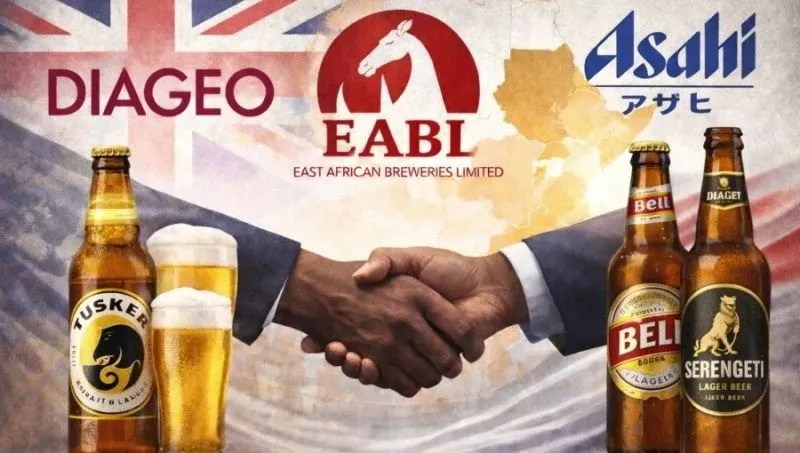
The global spirits industry is undergoing a quiet but profound realignment. As consumer tastes evolve, geopolitical risks intensify, and capital costs rise, multinational producers are reassessing where and how they deploy capital. One of the clearest illustrations of this shift is unfolding in East Africa, where Diageo is seeking to complete a landmark divestment that would mark the end of its direct ownership of one of the region’s most iconic beer businesses.
At the centre of the story is Diageo’s proposed sale of its controlling stake in East African Breweries Limited (EABL) to Japan’s Asahi Group Holdings Ltd.. Valued at approximately US$2.3 billion, the transaction is not only one of the largest corporate deals in East Africa’s recent history but also a defining chapter in Diageo’s broader retreat from African beer markets.
While the transaction has attracted investor interest and strategic commentary, it has also encountered legal turbulence at home. Kenya’s High Court recently postponed a hearing aimed at blocking the deal, setting a new date of January 20. Crucially, however, the court allowed the companies to continue pursuing regulatory approvals in the interim—a decision that has reshaped market sentiment and underscored the difference between procedural delays and substantive legal threats.
Build the future you deserve. Get started with our top-tier Online courses: ACCA, HESI A2, ATI TEAS 7, HESI EXIT, NCLEX-RN, NCLEX-PN, and Financial Literacy. Let Serrari Ed guide your path to success. Enroll today.
A Court Delay, Not a Deal Stopper
The High Court’s decision to defer the hearing did not amount to an injunction against the transaction itself. Instead, the court issued what was described as a temporary preservation order, narrowly focused on preventing the final execution of the sale for a limited period. The order was valid for just 11 days and did not restrict preparatory steps such as regulatory consultations or approval processes.
From EABL’s perspective, the court’s direction was largely procedural rather than disruptive. The company emphasized that transactions of this scale require months of engagement with regulators across multiple jurisdictions. In that context, a short-term preservation order does little to alter the transaction’s structure or strategic rationale.
This distinction matters. In large cross-border acquisitions, particularly those involving publicly listed entities and multiple regulators, delays are often interpreted by markets as signals of deeper trouble. In this case, however, the court’s decision appears to have reinforced the view that the legal challenge is peripheral rather than existential.
The Legal Challenge: Legacy Dispute Meets Global Deal
The case seeking to halt the sale was filed by Bia Tosha, a local beer distributor whose dispute with EABL dates back to 2016. According to EABL, the litigation has no factual or legal connection to the proposed transaction with Asahi. The brewer has maintained that both it and its Kenyan subsidiary are well positioned to defend the matter without jeopardizing the sale.
From a corporate governance standpoint, such disputes are not uncommon. Legacy commercial disagreements can resurface during major transactions, often as counterparties seek leverage or redress. What is notable here is the court’s apparent recognition that the underlying dispute does not automatically invalidate or undermine a global transaction involving international shareholders and regulatory oversight.
For Diageo and Asahi, the legal challenge introduces timing uncertainty rather than strategic doubt. The revised hearing date creates a short window of ambiguity, but the permission to proceed with regulatory steps suggests that the court does not view the challenge as grounds for freezing the entire process.
One decision can change your entire career. Take that step with our Online courses in ACCA, HESI A2, ATI TEAS 7, HESI EXIT, NCLEX-RN, NCLEX-PN, and Financial Literacy. Join Serrari Ed and start building your brighter future today.
Market Reaction: Investors Read Between the Lines
Financial markets were quick to interpret the court’s decision. Diageo’s shares rose by around 2 percent in London trading following news of the postponement. The stock climbed to roughly 1,634 pence, recovering from a sharp decline earlier in the week that had pushed it close to the lower end of its 52-week trading range.
This rebound was notable not only for its magnitude but also for its timing. Just days earlier, Diageo shares had fallen more than 4 percent, reflecting broader investor unease amid fluctuating global markets. The partial recovery following the Kenyan court ruling suggests that investors viewed the delay as a relief rather than a setback.
The broader FTSE 100 was up approximately 0.4 percent during the same session, indicating that Diageo’s gains outpaced the wider market. This divergence points to deal-specific optimism rather than a general risk-on rally.
In essence, investors appear to have concluded that the legal challenge is unlikely to derail the transaction, and that Diageo’s strategic logic remains intact.
Understanding the Deal: What Is Being Sold?
At the heart of the transaction is Diageo’s 65 percent stake in EABL, a company that occupies a dominant position in East Africa’s alcoholic beverages market. The deal also includes Diageo’s 53.7 percent shareholding in UDVK, a Kenyan spirits business, bringing the total consideration to US$2.3 billion.
The valuation implies an enterprise value of approximately US$4.8 billion for EABL, reflecting both its strong market position and its long-established brands. Upon completion, Diageo would retain no direct equity stake in the African beer business, marking a clean break from operational ownership in the region.
For Asahi, the acquisition represents a significant expansion into African markets at a time when growth in traditional beer consumption has slowed in parts of Asia and Europe. For Diageo, it is a decisive step in a broader portfolio realignment.
Diageo’s Africa Strategy: A Pattern of Exits
The proposed EABL sale is not an isolated event. Over the past several years, Diageo has systematically reduced its direct exposure to African beer operations, opting instead for brand ownership, licensing arrangements, or full exits.
This strategy has unfolded in stages:
- In 2023, Diageo sold its Guinness Cameroon subsidiary to France’s Castel Group.
- In October 2024, the company disposed of its stake in Guinness Nigeria, transferring ownership to Singapore-based conglomerate Tolaram.
- In July 2025, Diageo finalized the sale of its majority stake in Seychelles Breweries to Phoenix Beverages, part of Mauritius-based IBL Group, while retaining brand ownership and establishing licensing and royalty agreements.
- During the same period, Diageo transferred its majority stake in Guinness Ghana Breweries to Castel Group under a similar contractual structure.
Together, these transactions reveal a clear pattern: Diageo is stepping back from capital-intensive brewing operations in Africa while preserving long-term brand value through alternative commercial arrangements.
Why Africa, and Why Now?
From a strategic standpoint, Diageo’s retreat from African beer assets reflects a confluence of factors rather than a single catalyst.
First, the company has been actively reducing debt and simplifying its balance sheet. Asset disposals provide immediate cash inflows that can be redeployed toward core markets or used to strengthen financial resilience.
Second, Diageo has faced headwinds in key global markets, including the impact of U.S. tariffs and shifting consumer preferences away from traditional alcoholic beverages. In this environment, management appears to be prioritizing markets where scale, margins, and regulatory predictability are strongest.
Third, African beer markets, while offering long-term demographic growth, also present operational complexities. Currency volatility, tax regimes, regulatory uncertainty, and infrastructure constraints can weigh on returns, particularly for multinationals with global performance benchmarks.
The sale of EABL therefore aligns with a broader recalibration rather than a loss of confidence in Africa per se.
EABL’s Position: Strong Brands, Regional Focus
For EABL itself, the transaction represents a change in ownership rather than a shift in identity. The company remains best known for producing Tusker, one of East Africa’s most recognizable beer brands. Its operations are anchored in Kenya, Uganda, and Tanzania, with distribution extending to more than ten countries across Africa and beyond.
EABL’s regional focus has long been a source of strength, allowing it to tailor products to local tastes while benefiting from economies of scale. The company’s listing on the Nairobi Securities Exchange has also made it a bellwether for investor sentiment toward East African consumer businesses.
Under Asahi’s ownership, EABL is expected to continue operating as a regional champion rather than a peripheral subsidiary. For employees, distributors, and consumers, continuity rather than disruption is the central narrative.
Regulatory Pathways and Timing Risks
Despite the court’s decision to allow regulatory processes to proceed, the transaction still faces multiple approval stages. These include competition authorities, sector regulators, and possibly foreign investment review bodies, depending on jurisdictional requirements.
Large cross-border deals often encounter delays during this phase, particularly when they involve dominant market players. However, there is no indication thus far that regulators have raised substantive objections to the transaction’s structure.
EABL has publicly welcomed the court’s decision, framing it as confirmation that the regulatory phase can continue unimpeded. This stance reflects confidence that the deal’s fundamentals meet both legal and policy thresholds.
Nevertheless, timing remains a variable. Prolonged legal proceedings could affect closing schedules, even if they do not alter outcomes. For Diageo, which is actively managing portfolio transitions, predictability matters almost as much as price.
Investor Interpretation: Exit or Evolution?
Among investors, the EABL sale has sparked debate about whether Diageo is retreating from growth markets or repositioning itself for a different phase of expansion.
On one hand, Africa’s youthful population and rising urbanization suggest long-term demand for branded consumer goods. Exiting such markets could be seen as foregoing future growth.
On the other hand, Diageo’s approach does not necessarily abandon Africa altogether. By retaining brand rights and licensing arrangements in some markets, the company continues to benefit from brand equity without bearing operational risk.
The EABL sale fits this hybrid logic: monetize ownership today while preserving optionality elsewhere.
Asahi’s Perspective: Strategic Expansion Beyond Asia
For Asahi, the acquisition represents a rare opportunity to acquire scale in African brewing through an established market leader. Unlike greenfield investments, EABL offers immediate access to brands, distribution networks, and regulatory relationships.
Asahi’s interest in EABL reflects broader trends among Asian brewers seeking geographic diversification. With beer consumption stagnating in some mature markets, Africa’s demographics and urban growth offer long-term upside.
At the same time, acquiring a well-run regional champion reduces execution risk compared to building operations from scratch.
The Broader Implications for East Africa’s Capital Markets
Beyond Diageo and Asahi, the transaction has implications for East Africa’s investment landscape. Large, transparent deals signal market maturity and can attract further institutional capital.
EABL’s valuation sets a benchmark for consumer-facing businesses in the region, while the court’s handling of the legal challenge provides insight into how Kenya’s judiciary navigates high-stakes commercial disputes.
For policymakers, the case underscores the importance of balancing investor protection with transactional certainty. For local companies, it highlights both the opportunities and vulnerabilities that accompany integration into global capital flows.
Short-Term Noise, Long-Term Direction
While headlines have focused on court dates and share price movements, the underlying story is one of strategic direction rather than episodic drama. The High Court’s postponement introduces short-term uncertainty but does not alter the structural forces driving the deal.
Diageo’s Africa exit has been deliberate, staged, and consistent. The EABL transaction is the culmination of that strategy, not an abrupt departure. Asahi’s entry reflects confidence in Africa’s long-term potential, even as ownership models evolve.
For EABL, the challenge will be to navigate this transition while maintaining brand strength, operational efficiency, and market leadership.
Conclusion: A Transaction That Mirrors a Changing Global Landscape
The delayed court hearing in Kenya has added a layer of complexity to one of East Africa’s most significant corporate transactions, but it has not derailed it. Instead, it has clarified the distinction between legal process and strategic intent.
Diageo’s proposed US$2.3 billion sale of its stake in East African Breweries to Asahi is emblematic of a wider reordering in global consumer goods markets. Capital is becoming more selective, ownership structures more flexible, and growth strategies more nuanced.
As the January 20 hearing approaches, attention will remain focused on legal developments. Yet the broader narrative is already clear: Diageo is completing a carefully orchestrated exit from African brewing operations, while Asahi is stepping into a region it believes will shape the next chapter of global beer consumption.
Whether viewed through the lens of strategy, markets, or policy, the EABL deal is less about a single court ruling and more about how multinational companies adapt to a world of shifting risks, evolving tastes, and increasingly complex global footprints.
photo source: Google
By: Elsie Njenga
20th January, 2026