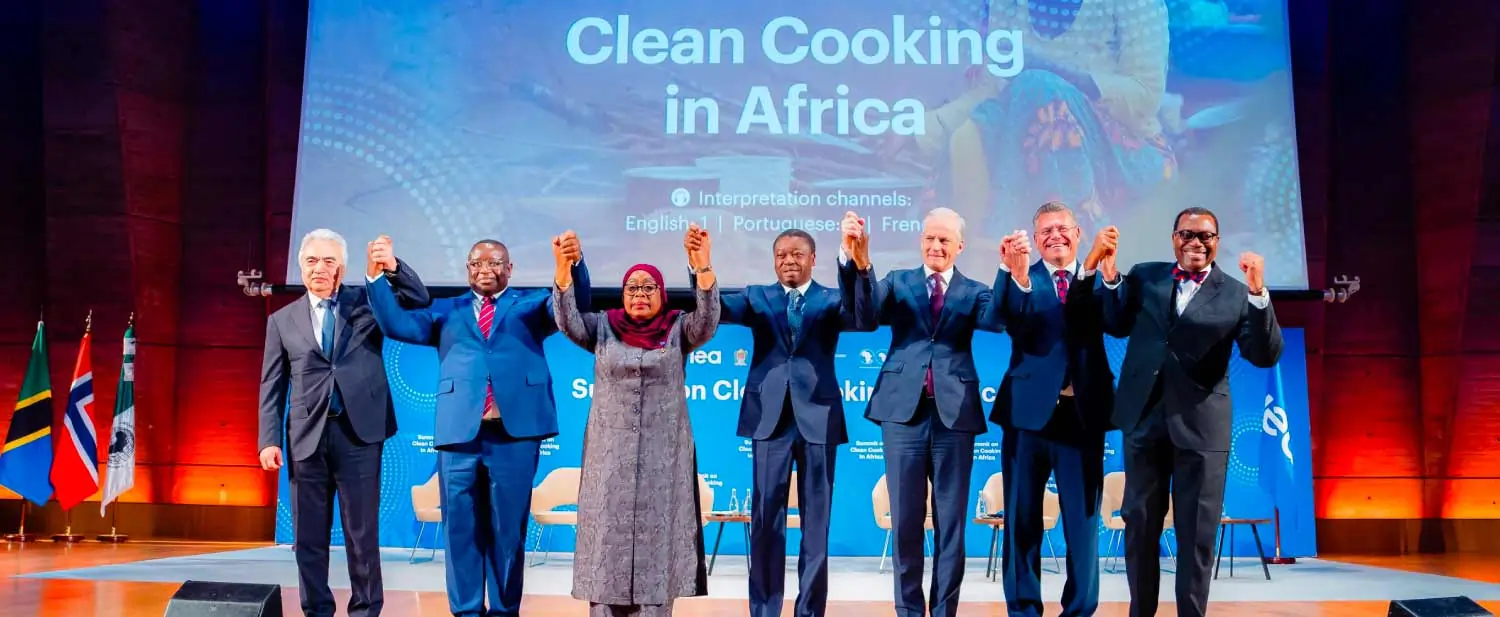
In a significant move aimed at transforming the cooking habits across the African continent, the African Development Bank (AfDB) is ramping up its investments in clean cooking solutions. This announcement comes as a beacon of hope for millions of Africans who continue to rely on traditional cooking methods that pose health risks and environmental concerns.
M-Gas: A Beacon of Clean Cooking Innovation in Nairobi
In Nairobi’s bustling informal settlement of Mukuru, a quiet revolution is underway, thanks to M-Gas, a company pioneering affordable and accessible clean cooking solutions. This initiative is changing the lives of many low-income households by offering a modern alternative to traditional, harmful cooking methods.
Take Aurelia Aureh, a Mukuru resident, for example. She has seen her life improve dramatically since switching from charcoal to M-Gas. “Before, I used to spend about Ksh50 (about $0.38) on charcoal for each cooking session,” she recalls. “Now, with M-Gas, I spend less than half that amount and enjoy the convenience of not having to deal with charcoal.”
M-Gas operates on a pay-as-you-cook model, allowing users to purchase liquid petroleum gas (LPG) in small, affordable amounts. This model is particularly beneficial for low-income households who might struggle with the upfront costs of traditional gas and LPG cylinders. “I don’t have to worry about running out of gas,” Aurelia adds. “M-Gas monitors my usage and ensures I never run out. I can just pay for what I use through M-Pesa.”
AfDB Vice President Explores Clean Cooking Innovations
The innovative approach of M-Gas caught the eye of Solomon Quaynor, the African Development Bank’s Vice President for Private Sector, Infrastructure, and Industrialization. During his visit to Nairobi in late July 2024, Quaynor explored potential collaborations to advance clean cooking solutions in the country.
Quaynor met with Martin Kimani, CEO of M-Gas, and discussed ways to partner in enhancing Africa’s energy transition. He also engaged with Circle Gas, the parent company of M-Gas, including board members such as Carey Ngini and Michael Joseph. This engagement highlighted the importance of partnerships in scaling up clean cooking solutions.
Quaynor’s visit took him to Mukuru, where he interacted with residents like Aurelia and saw firsthand the impact of clean cooking technology. The experience underscored the significant benefits of switching from traditional methods to cleaner alternatives.
Health and Environmental Benefits of Clean Cooking
The transition to clean cooking methods is not just about convenience; it has profound health and environmental benefits. Mercy Karimi, another resident of Mukuru, shared how M-Gas improved her family’s health. “Before, my daughter had frequent chest infections from the fumes of kerosene. Since we started using M-Gas, her health has improved significantly,” she says.
The use of traditional cooking methods such as open fires and basic stoves exposes families to harmful smoke and fumes, which can lead to respiratory issues and other health problems. Women and children, who are often responsible for cooking, are particularly vulnerable to these health risks.
AfDB’s $2 Billion Commitment to Clean Cooking
The African Development Bank’s pledge of $2 billion over the next decade is a major commitment towards promoting clean cooking solutions across Africa. This initiative aims to save the lives of approximately 600,000 people annually, who suffer from health issues related to smoke from biomass and charcoal.
Despite progress in increasing electricity access, the adoption of clean cooking technologies has lagged. Approximately one billion people across Africa still rely on traditional cooking methods, which have significant health and environmental impacts. The AfDB’s investment is designed to bridge this gap, making clean cooking solutions more accessible and affordable.
Quaynor’s visit to the M-Gas depot in Ruaka, a suburb north-west of Nairobi, provided insights into the practical benefits of this technology. He met with residents and business owners who have embraced M-Gas, hearing firsthand how it has improved their lives. Stephen Njogu, a local resident, noted, “M-Gas is a game-changer. I can buy gas in small amounts and avoid the smoke and hassle of kerosene.”
Faith Kamau, who runs a small eatery in Ruaka, also praised M-Gas. “I can cook efficiently and save money, which I use to buy more food stock. The customer service is excellent, and any issues are resolved quickly.”
Advancing Africa’s Energy Transition
The AfDB’s commitment to investing $200 million annually is a crucial step towards addressing energy poverty and supporting the clean cooking transition. However, this funding represents only a fraction of the estimated $4 billion needed each year to ensure widespread access to clean cooking solutions by 2030. The Bank’s efforts are part of a broader strategy to achieve Sustainable Development Goal 7 (SDG7), which focuses on providing affordable, reliable, sustainable, and modern energy for all.
The clean cooking sector stands to benefit from increased investments and collaborations. The involvement of private sector players like M-Gas and its partners will be essential in scaling up solutions and reaching underserved communities. By integrating innovative technologies and expanding access to affordable clean cooking options, the AfDB and its partners are paving the way for a healthier and more sustainable future.
Overcoming Challenges and Looking Ahead
While the AfDB’s commitment is a positive development, there are challenges that need to be addressed. The high upfront costs of clean cooking technologies and the need for effective distribution networks remain significant barriers. Additionally, changing long-standing cooking habits and preferences will require sustained efforts and comprehensive awareness campaigns.
The AfDB’s strategy includes supporting research and development, encouraging private sector investments, and fostering regional collaborations. These measures are critical for overcoming the challenges of transitioning to clean cooking across diverse African contexts.
In conclusion, the African Development Bank’s intensified focus on clean cooking solutions marks a pivotal moment in Africa’s energy transition journey. By investing in innovative technologies and forging strategic partnerships, the Bank is making a significant contribution to improving the health and well-being of millions across the continent. As this initiative unfolds, it will be crucial to monitor progress, address challenges, and continue to foster collaboration to achieve the goal of universal access to clean cooking by 2030.
photo source: Google
By: Montel Kamau
Serrari Financial Analyst
8th August, 2024