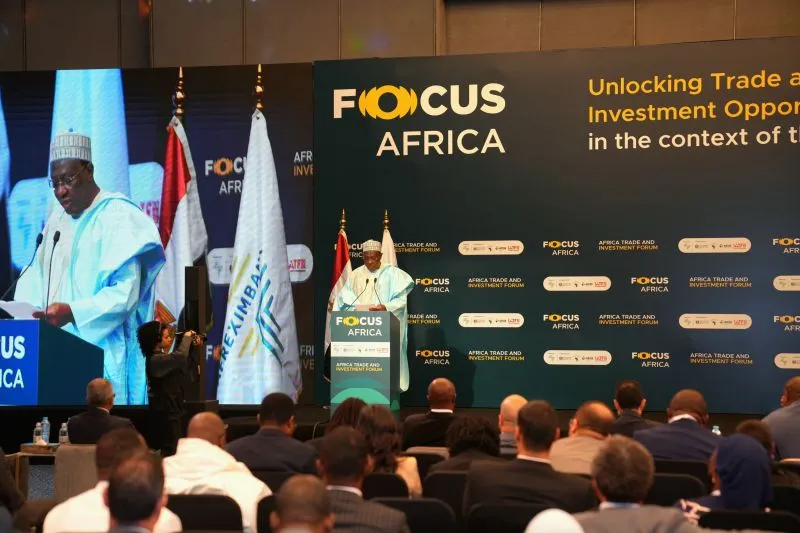
The African Export-Import Bank (Afreximbank), in partnership with Egypt’s Ministry of Planning, Economic Development and International Cooperation (MoPEDIC) and the Group of African Ambassadors in Cairo, convened the first-ever FOCUS Africa Trade and Investment Forum on 15–16 April 2025 in Cairo. Bringing together policymakers, business leaders, investors, and diplomats, the Forum showcased bankable projects, tackled Africa’s infrastructure financing gap, and charted a path toward deeper intra‑continental trade under the landmark African Continental Free Trade Area (AfCFTA).
A pivotal gathering at a decisive moment
Against a backdrop of sluggish global growth and mounting geopolitical tension, Africa stands at a crossroads. With 1.4 billion people and a combined GDP exceeding USD 3.1 trillion, the continent’s promise is enormous—but under‑leveraged. FOCUS Africa was designed to bridge the gap between ambition and action by spotlighting opportunities across agribusiness, technology, infrastructure, logistics, energy, manufacturing, mining, tourism, and the blue economy.
Her Excellency Dr Rania Al‑Mashat, Egypt’s Planning Minister, set the tone: “Intra‑African trade makes up only 15 percent of our total trade. Through policy reforms, private‑sector development now accounts for 63 percent of investments in Egypt, yet we must work harder to unlock the potential of AfCFTA’s single market—our pathway to inclusive growth.”
AfCFTA: From vision to reality
Launched in January 2021 after the requisite 22 ratifications, the AfCFTA now counts 54 signatory countries, 47 of which have formally deposited their instruments of ratification UNECA. Eritrea remains the only AU member yet to sign, while seven others have signed but await parliamentary approval fDi Intelligence.
The Agreement promises a unified market of 1.4 billion consumers, harmonized tariffs, and simplified customs procedures. Yet three years on, intra‑African merchandise trade still lags—underscoring the need for transaction‑ready infrastructure, regulatory alignment, and private‑sector engagement. FOCUS Africa aimed to address these bottlenecks head‑on.
An infrastructure financing gap that holds back growth
Africa’s annual infrastructure financing needs are staggering. Estimates range from USD 130 billion to USD 170 billion each year in transport, energy, and water systems alone World Bank Blogs. The African Development Bank puts the figure even higher—between USD 181 billion and USD 221 billion per annum over 2023–2030—to meet electrification, roads, and port‑capacity targets African Development Bank Group. Meanwhile, climate‑related investments require an additional USD 213 billion annually.
Afreximbank’s Intra‑African Engineer Procure Construct (EPC) Initiative aims to turn this challenge into opportunity by mobilizing homegrown contractors and financiers for continent‑wide projects. By shifting from externally driven projects to African‑led execution, the Bank believes costs can be contained, local skills scaled, and regional value chains strengthened.
Mobilizing domestic and international capital
Despite attracting just 3 percent to 4 percent of global foreign direct investment (FDI), Africa saw FDI inflows of USD 53 billion in 2023—a 3 percent decline year on year UN Trade and Development (UNCTAD). In contrast, 2024 witnessed a record surge to USD 94 billion, driven largely by a single mega‑project in Egypt’s Ras El‑Hekma peninsula; stripping out that anomaly, flows rose 23 percent to around USD 50 billion Ecofin Agency.
While headline numbers impress, FDI remains unevenly distributed: North and West Africa garner the lion’s share, whereas Central Africa and much of Southern and East Africa compete for much smaller slices of the investment pie. Addressing this imbalance was a central theme at FOCUS Africa.
Sector deep dives: Where impact meets returns
Agribusiness and agro‑processing
With 60 percent of the world’s uncultivated arable land, Africa’s farm output could triple. Yet post‑harvest losses average 30 percent due to weak storage and logistics. At the Forum, a panel highlighted how cold‑chain startups in Kenya and Nigeria are partnering with regional produce exporters to halve spoilage rates—an investment case for refrigerated warehouses under public‑private partnerships.
Technology and digital infrastructure
Only 43 percent of Africans had internet access in 2023, compared with over 80 percent in Latin America. Bridge‑building requires fiber‑optic deployment, data centers, and mobile‑money interoperability. Delegates heard from pan‑African cloud‑services firms that have cut local data‑hosting costs by 25 percent—proof that investing in digital enablers can unlock e‑commerce under AfCFTA.
Energy and renewables
Six hundred million Africans still lack electricity. The Bank’s “Mission 300” initiative aims to electrify 300 million people by 2030, leveraging solar mini‑grids and green‑hydrogen projects Time. FOCUS Africa featured a showcase of off‑grid solar firms in Tanzania that have signed pay‑as‑you‑go contracts with 1 million rural households—illustrating how innovative financing can drive rapid scale.
Logistics and transport
Africa’s logistics costs are three to five times higher than global benchmarks. The Afreximbank‑backed Pan‑African Payment and Settlement System (PAPSS) was spotlighted for slashing cross‑border transaction times from days to minutes, demonstrating the knock‑on benefits for trucking and freight‑forwarding companies operating under AfCFTA corridors.
Humanizing the numbers: Voices from the ground
At a B2B matchmaking session, Ms Amina Adamu—a small‑scale poultry farmer in Kaduna, Nigeria—described her frustration with export paperwork and multiple inspections that ate into her razor‑thin margins. After connecting with a logistics startup at FOCUS Africa, she now ships poultry to Côte d’Ivoire in half the time and at one‑third the previous cost. “This is more than trade,” she said through tears of relief. “It’s livelihood security for my family.”
Meanwhile, Mr Jean‑Claude Ndayishimiye, CEO of a Rwandan solar‑tech cooperative, recounted how EPC contracts backed by local pension‑fund capital have enabled his firm to install solar power in 50 village schools—projects that once would have required multilateral donor grants. “African capital for African solutions,” he noted, “is no longer a slogan but a reality.”
Egypt’s reforms: A case study in private‑sector activation
Dr Al‑Mashat highlighted Egypt’s own journey: private investment now represents 63 percent of total investment, up from 45 percent five years ago, after streamlined regulations and improved fiscal management. The nation has set targets to attract USD 60 billion in FDI by 2030 and raise annual exports to USD 145 billion—leveraging its Suez‑Canal corridor and industrial zones as gateways to Africa. This progress demonstrates how host governments can create conducive environments for both intra‑African and extra‑continental investors.
Leadership voices: Charting a new globalization
Prof Benedict Oramah, Afreximbank’s President, challenged the status quo: “Globalization as we know it is under life support. AfCFTA gives us the chance to build our own internal globalization—a truly African market that can then project outward.” He urged participants to see the Bank’s USD 1 billion Intra‑African Trade Fund, announced in 2023, as a catalyst for leveraging another USD 5 billion in co‑financing from sovereign, private‑equity, and development partners.
Mrs Kanayo Awani, Executive Vice President for Intra‑African Trade and Export Development, emphasized the EPC model’s strategic importance: “Scaling local capacity through EPC not only bridges financing gaps but turns contractors into regional champions. The era of importing all project expertise is over.”
Building on momentum: Next steps and measurable goals
FOCUS Africa 2025 concluded with a roadmap for action:
- Matchmaking deliverables: Over 200 bilateral meetings scheduled to fast‑track five infrastructure pilots—three solar‑power parks, a trans‑border rail link, and a regional cold‑chain hub.
- Financing commitments: USD 750 million of term loans and guarantees pledged by Afreximbank for priority projects before year‑end.
- Policy reform task force: A joint Afreximbank–AU commission to benchmark best practices in tariff liberalization and non‑tariff barrier removal, with quarterly progress reports.
These concrete outcomes aim to ensure that Forum dialogue translates into transactions and measurable upticks in intra‑African trade volumes—currently stuck at 15 percent of total trade under AfCFTA’s full potential.
A shared vision for collective prosperity
As the curtains fell on Cairo’s Dusit Thani Hotel, a sense of optimism prevailed. H.E. Dr Mohamadou Labarang, Dean of the African Ambassadors’ Group, reminded attendees that “partnerships built on mutual benefit, shared growth, and strategic vision” will forge the continent’s path forward. With AfCFTA as the guiding framework, and Afreximbank’s financial muscle and convening power, Africa’s quest for economic self‑sufficiency and inclusive prosperity has found a powerful ally.
The real test lies ahead: translating 150 pages of policy into 15 million jobs, USD 500 billion in intra‑continental trade, and the infrastructure that turns borders into bridges. But if FOCUS Africa has shown anything, it is that Africa can—and will—finance its own future.
Ready to take your career to the next level? Join our dynamic courses: ACCA, HESI A2, ATI TEAS 7 , HESI EXIT , NCLEX – RN and NCLEX – PN, Financial Literacy!🌟 Dive into a world of opportunities and empower yourself for success. Explore more at Serrari Ed and start your exciting journey today! ✨
photo source: Google
By: Montel Kamau
Serrari Financial Analyst
17th April, 2025