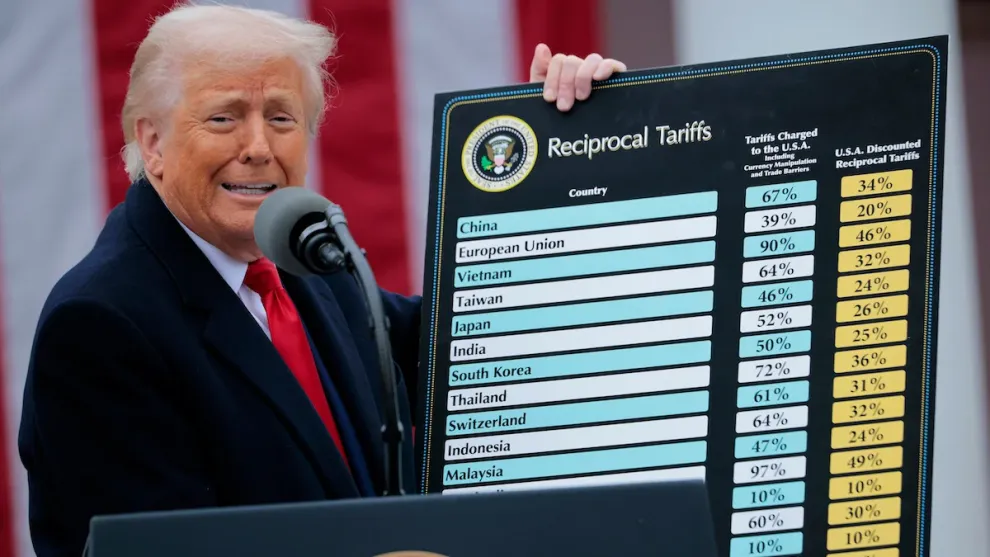
In a watershed moment for American trade policy, the U.S. Supreme Court delivered a sweeping 6-3 rebuke to President Donald Trump on February 20, 2026, ruling that he had exceeded his constitutional authority by using the 1977 International Emergency Economic Powers Act (IEEPA) to impose sweeping import tariffs on virtually all of America’s trading partners. The decision, authored by Chief Justice John Roberts, held plainly that “IEEPA does not authorize the President to impose tariffs,” drawing a clear line between executive trade authority and the constitutional power of the purse, which belongs to Congress.
The majority was an unusual coalition: Roberts was joined by fellow conservatives Neil Gorsuch and Amy Coney Barrett — both Trump appointees — alongside the court’s three liberal justices: Sonia Sotomayor, Elena Kagan, and Ketanji Brown Jackson. Justices Clarence Thomas, Samuel Alito, and Brett Kavanaugh dissented, with Kavanaugh notably warning that “the Court’s decision is not likely to greatly restrict Presidential tariff authority going forward” — a line Trump himself repeatedly cited at a combative White House press conference shortly after the ruling.
Trump’s response was immediate and furious. He called the ruling “ridiculous, poorly written, and extraordinarily anti-American” and labelled the majority justices “fools and lapdogs,” singling out Gorsuch and Barrett as “embarrassments to their families.” Yet within hours, he had signed a new executive order invoking a different and previously untested statute to keep his tariff war alive.
Build the future you deserve. Get started with our top-tier Online courses: ACCA, HESI A2, ATI TEAS 7, HESI EXIT, NCLEX-RN, NCLEX-PN, and Financial Literacy. Let Serrari Ed guide your path to success. Enroll today.
Section 122: The New Legal Foundation — and Its Limits
The administration’s pivot rested on Section 122 of the Trade Act of 1974, a provision designed to address balance-of-payments crises. The statute grants the president authority to impose a temporary import surcharge of up to 15% ad valorem for a maximum of 150 days, after which congressional approval is required to extend them. Crucially, no president has ever invoked Section 122 in this manner before, meaning there is no legal precedent to guide courts assessing its use — a reality that trade lawyers say virtually guarantees further litigation.
Late on February 20, Trump signed an executive order imposing a 10% global tariff under Section 122, effective February 24, 2026. Less than 24 hours later, on February 21, he announced via Truth Social that he was raising it to the maximum statutory rate of 15%, effective immediately. “I, as President of the United States of America, will be, effective immediately, raising the 10% Worldwide Tariff on Countries, many of which have been ‘ripping’ the U.S. off for decades, without retribution (until I came along!), to the fully allowed, and legally tested, 15% level,” Trump wrote.
The Section 122 tariffs include exemptions for USMCA-qualifying goods from Canada and Mexico, goods subject to Section 232 tariffs (such as steel and aluminum), critical minerals, pharmaceuticals, and certain electronics. For goods partially covered by Section 232 duties, the Section 122 levy applies only to the uncovered portion. The Section 122 tariffs will technically expire on July 24, 2026, unless Congress votes to extend them — a prospect that, according to trade experts and congressional aides, looks unlikely given surveys showing growing voter concern over tariff-driven price increases.
The administration’s calculation is transparent: use the 150-day window to rebuild a parallel tariff architecture through other legal channels. Treasury Secretary Scott Bessent told the Economic Club of Dallas that deploying alternative authorities “will result in virtually unchanged tariff revenue in 2026.”
Searching for Other Tariff Paths: Sections 232 and 301
The White House has been explicit that Section 122 is a temporary bridge, not a destination. The administration’s longer-term plan is to re-impose tariffs through two additional statutes: Section 232 of the Trade Expansion Act of 1962, which allows tariffs on national security grounds following a Commerce Department investigation, and Section 301 of the Trade Act of 1974, which permits duties in response to unfair foreign trade practices after an investigation by the U.S. Trade Representative.
Both pathways are substantially more constrained than IEEPA. Section 232 investigations can take up to 270 days for the Commerce Department to report to the President, with additional decision and implementation windows thereafter. Section 301 tariffs cannot be applied universally — they target specific countries engaged in discriminatory practices — making a blanket global tariff difficult to achieve. During Trump’s first term, these were the primary instruments used for tariffs on China’s goods, but they would not permit, for instance, a 50% duty on imports from a country like Brazil.
The Council on Foreign Relations noted that “in the end, between the Section 122 tariff, plus any subsequent tariffs imposed under Sections 232 and 301, most could end up being pretty close to where they are now” — but the path there will be slower, more procedurally intensive, and politically fraught heading into November’s midterm elections.
One decision can change your entire career. Take that step with our Online courses in ACCA, HESI A2, ATI TEAS 7, HESI EXIT, NCLEX-RN, NCLEX-PN, and Financial Literacy. Join Serrari Ed and start building your brighter future today.
A $175 Billion Refund Question Left Unanswered
One of the most consequential unresolved issues from the Supreme Court ruling is the question of refunds. According to a projection by Penn Wharton Budget Model economists, reversing the IEEPA tariffs could generate up to $175 billion in refunds to importers. The U.S. Customs and Border Protection agency had already collected approximately $133 billion in IEEPA tariffs as of mid-December 2025, with revenue running at roughly $500 million per day at peak rates.
The Supreme Court’s opinion, however, said nothing about how or whether refunds should be processed. Justice Kavanaugh, in his dissent, criticised the majority for leaving importers in limbo: “The Court says nothing today about whether, and if so how, the Government should go about returning the billions of dollars that it has collected from importers.” He called the prospective refund process likely to be a “mess,” echoing remarks from the oral arguments in November 2025.
Nearly 2,000 importers had already filed cases at the Court of International Trade (CIT) ahead of the ruling, and trade lawyers expect the CIT to become the primary venue for hashing out a refund mechanism. Companies such as Costco, Revlon, and Bumble Bee Foods had proactively filed suits at the CIT to preserve their rights. TD Securities estimates that any refunds that do get processed will take 12 to 18 months to roll out, and the process is likely to involve both administrative procedures at CBP and litigation at the CIT — a combination that trade attorney Joyce Adetutu of Vinson & Elkins described as “a bumpy ride for a while.” Critically, any refunds would go back to the importers, not to the consumers who bore the higher prices.
Trump himself declared at the February 20 press conference that the refund fight could drag on for years, and made clear his administration has no intention of facilitating the process voluntarily. The Penn Wharton analysts warned that unless the IEEPA tariff revenue is replaced through other statutory authorities, future tariff collections could fall by roughly half — a significant fiscal exposure for an administration that has positioned tariff revenue as central to its fiscal strategy.
Trade Deals Remain in Force — But the Global Tariff Landscape Shifts
One of the more complex dimensions of the new tariff landscape concerns countries that had previously negotiated bilateral trade agreements with Washington under the shadow of IEEPA tariffs. Trump’s trade representative, Jamieson Greer, confirmed that those agreements remain in force regardless of the Supreme Court ruling, even where the agreed tariff rates exceed the new 15% global floor. Countries such as Malaysia and Cambodia, which secured negotiated rates of 19%, will continue to export to the U.S. at those rates rather than benefiting from the lower Section 122 tariff. Indonesia’s chief negotiator, Airlangga Hartarto, confirmed that a trade deal setting a 19% U.S. tariff rate, signed on February 20, remains in force despite the court ruling.
For countries that have not signed agreements with Washington, the picture is more encouraging — at least temporarily. Brazil, for example, faced a 40% IEEPA tariff rate and had not reached a deal with the Trump administration; it could now see its effective tariff rate drop to 15%, at least for the 150-day window during which Section 122 is in force. The relief, however, is likely to be short-lived if the administration succeeds in rebuilding tariff walls through Sections 232 and 301 before July 24.
World leaders reacted to the ruling with a mix of relief and caution. French President Emmanuel Macron praised the decision as evidence that democracies benefit from counterweights to executive power. German Chancellor Friedrich Merz said the ruling would ease the burden on German companies and pledged to reiterate during his upcoming U.S. visit that “tariffs harm everyone.” European Central Bank President Christine Lagarde warned Sunday that the latest tariff moves still create significant uncertainty for the eurozone economy and could jeopardise the terms of existing EU-U.S. trade arrangements. France’s trade minister Nicolas Forissier called for a united EU response and said Brussels has the tools to respond if needed.
Political and Economic Fallout: Midterms Loom Large
The tariff drama is unfolding against a volatile political backdrop. A Reuters/Ipsos poll that closed on February 17, 2026 found that only 34% of respondents approve of Trump’s handling of the economy, while 57% disapprove — a sharp deterioration for a president whose second term began on the strength of economic promises. Democrats, who need to flip just three Republican-held seats in the House of Representatives to win a majority in November, have made affordability the centrepiece of their midterm strategy, framing tariffs as a self-inflicted tax on American consumers.
The average U.S. tariff rate on all imports had reached approximately 17% prior to the Supreme Court ruling, incorporating the full IEEPA tariff regime. With the IEEPA duties struck down, economists at BMO Capital Markets estimate the effective rate could fall to around 7% — before the Section 122 surcharge is factored in. A Federal Reserve Bank of New York analysis published earlier found that U.S. businesses and consumers absorbed nearly 90% of the cost of Trump’s 2025 tariffs, a figure the administration contests.
For small businesses, the ruling offered some respite, even as uncertainty persists. We Pay the Tariffs, an advocacy group representing 800 small businesses that opposed the IEEPA tariffs, said the levies had forced member companies to take out loans and freeze hiring. The group’s executive director, Dan Anthony, described the ruling as “a tremendous victory for America’s small businesses” and urged the White House to issue “full, fast and automatic refunds.” The consumer-facing price relief, however, remains in question: retailers such as Walmart had already announced price hikes tied to tariff costs, and economists caution that supply chains and pricing structures do not unwind quickly.
The timing is particularly fraught because Trump is scheduled to deliver his State of the Union address to Congress on February 25 — just days after one of the most significant legal defeats of his presidency. The administration will need to present a coherent trade strategy to a Congress skeptical of extending Section 122 tariffs past their 150-day expiration, even as the president insists he has the right to do “pretty much what we want to do” on tariffs without legislative buy-in.
What Comes Next: An Uncertain Path Through the Courts and Congress
Legal and trade experts broadly agree that the Section 122 tariffs are themselves vulnerable to court challenge, given that the statute has never been used in this context and raises untested questions about the scope of presidential authority in balance-of-payments situations. Chatham House analysts noted that each of Trump’s remaining tariff instruments — Sections 122, 232, and 301 — “entails procedural hurdles, evidentiary thresholds, time limits and litigation risks.” Any of these could wind up before the courts in the months ahead.
For the administration, the clock is now ticking on multiple fronts simultaneously: the Section 122 tariffs expire in July 2026, Section 232 investigations require months of Commerce Department process, and Section 301 actions must be country- or product-specific rather than universal. CFR President Michael Froman warned that the combination of these constraints means “the timing of the decision in an election year could make this a politically fraught issue” — particularly if the administration tries to re-impose higher tariffs just as voters are heading to the polls.
For global markets and trading partners, Chatham House’s assessment that “uncertainty will continue to be the name of the game” is apt. Countries with existing trade deals face the paradox of honouring agreements that lock in rates above the new 15% floor. Nations without deals face temporary reprieve followed by potentially escalated tariffs once Section 232 and 301 investigations conclude. And all U.S. trading partners must now factor in the possibility that the Section 122 tariffs could be challenged in court before the July deadline — adding yet another layer of unpredictability to global supply chain planning.
What is clear is that the Supreme Court’s ruling, while historic, has not ended America’s trade war — it has merely reshuffled its legal architecture. The core political and economic debate about whether tariffs serve U.S. interests or impose undue costs on consumers and businesses remains as contested as ever, with the November midterm elections ensuring that every tariff decision from here carries outsized political consequence.
Ready to take your career to the next level? Join our Online courses: ACCA, HESI A2, ATI TEAS 7 , HESI EXIT , NCLEX – RN and NCLEX – PN, Financial Literacy!🌟 Dive into a world of opportunities and empower yourself for success. Explore more at Serrari Ed and start your exciting journey today! ✨
Track GDP, Inflation and Central Bank rates for top African markets with Serrari’s comparator tool.
See today’s Treasury bonds and Money market funds movement across financial service providers in Kenya, using Serrari’s comparator tools.
photo source: Google
By: Montel Kamau
Serrari Financial Analyst
23rd February, 2026