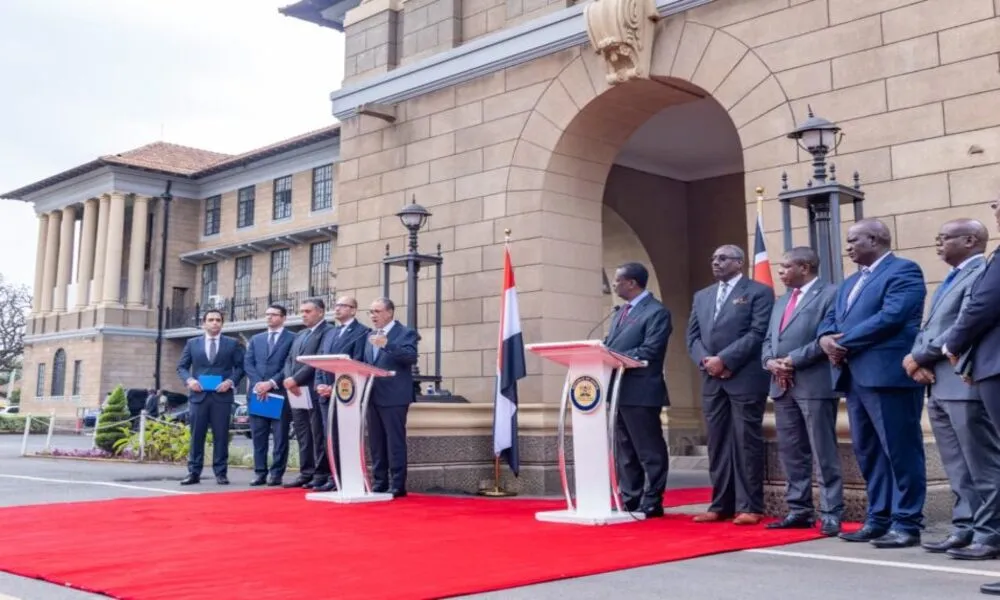
When Egypt’s Foreign Minister Badr Abdelatty landed in Nairobi this week, he did not arrive empty-handed. He carried a written message from President Abdel Fattah el-Sisi, a proposed $100 million financing mechanism for dam construction, pledges to redirect a chunk of Egypt’s $14 billion African investment portfolio toward Kenya, and a carefully worded diplomatic offensive on the Nile Basin dispute with Ethiopia. The visit, conducted alongside Water Resources and Irrigation Minister Hani Sewilam, signals that Cairo is working methodically to convert a year-old strategic partnership into something far more tangible — and politically consequential.
The talks in Nairobi on February 16–17 were the highest-level Egypt-Kenya engagement since President William Ruto’s state visit to Cairo in January 2025, during which the two governments signed 12 bilateral agreements and formally elevated relations to a Strategic and Comprehensive Partnership. That Cairo Declaration set out an ambitious framework spanning political consultations, investment facilitation, port cooperation, space technology, education, and security. The Nairobi meetings this week are, in Cairo’s telling, the implementation phase an effort to move from declarations to deliverables.
Build the future you deserve. Get started with our top-tier Online courses: ACCA, HESI A2, ATI TEAS 7, HESI EXIT, NCLEX-RN, NCLEX-PN, and Financial Literacy. Let Serrari Ed guide your path to success. Enroll today.
Sisi’s Personal Message and the Weight Behind It
The symbolic centrepiece of the visit was Abdelatty’s delivery of a written message from President el-Sisi to President Ruto, conveying Cairo’s appreciation for the bilateral relationship and reaffirming the commitment to the strategic partnership. Abdelatty described Kenya as his “second home” and noted that President el-Sisi personally oversees efforts to expand ties beyond politics into trade, culture and investment — language that signals the relationship is being managed at the very top of the Egyptian government.
The Egyptian foreign minister also met with Kenyan Prime Cabinet Secretary and Foreign Affairs Minister Musalia Mudavadi, where both sides acknowledged that diplomatic relations between Egypt and Kenya date back to 1964 and have deepened across political, economic, defence and social dimensions. Mudavadi welcomed Cairo’s approach and pledged that Kenya remains committed to advancing the strategic and comprehensive partnership as a platform for regional stability, economic growth, and African-led solutions.
For his part, President Ruto praised Egypt’s role in promoting stability across Africa and the Middle East and reaffirmed Kenya’s commitment to deepening bilateral cooperation, asking that his personal greetings be conveyed back to President el-Sisi.
The Economic Agenda: Trade, Manufacturing, and Ports
While the diplomatic language is warm, the economic substance of the visit is where Cairo has invested serious ambition. According to data cited by Abdelatty, bilateral trade between Egypt and Kenya reached approximately $567 million in 2024 — a figure both governments acknowledge falls well short of the potential given the size and complementarity of their respective economies. Egyptian exports to Kenya were dominated by packaging, building materials, chemicals, and food products, while Kenya’s primary export to Egypt is tea. Both sides now want to substantially grow and diversify that exchange.
Egypt has signalled its readiness to redirect a significant portion of its estimated $14 billion African investment portfolio toward Kenya, targeting sectors including infrastructure, agro-industry, pharmaceuticals, and renewable energy. According to Egypt Today, a central piece of the economic agenda is a proposal for Egyptian-led industrial and logistical zones at the ports of Lamu and Mombasa, which would establish a physical anchor for Cairo’s expanded commercial presence in East Africa. To support Egyptian firms moving into the Kenyan market, the Egyptian Agency for Export and Investment Guarantee is being deployed to mitigate investment risk.
In the pharmaceutical sector, Abdelatty expressed Egypt’s willingness to localise medical manufacturing in Kenya through a phased transfer of technology, beginning with “fill and finish” production lines — a move aligned with Kenya’s own push to build domestic pharmaceutical manufacturing capacity. The two sides also moved to fast-track the Kenya-Egypt Joint Business Council, focusing on streamlining customs procedures, addressing non-tariff barriers and expanding private sector engagement across priority industries.
A more ambitious maritime proposal was also floated: the establishment of a joint shipping line connecting Egypt’s Red Sea ports with Kenya’s Indian Ocean ports at Mombasa and Lamu — a “Blue Economy” initiative that would reduce freight costs, improve trade facilitation, and give Egypt a commercial corridor deeper into East and Central Africa.
The $100 Million Dam Fund: Water Diplomacy With Strings Attached
The most consequential single announcement from the Nairobi visit is Egypt’s proposed Nile Development Fund, initially capitalised at $100 million to finance feasibility studies and the implementation of dam projects in southern Nile Basin countries. Minister Sewilam confirmed Egypt’s readiness to expand technical cooperation with Kenya specifically in groundwater drilling, rainwater harvesting dams, and modern irrigation systems, as well as broader capacity-building programmes supporting Kenya’s water infrastructure and climate resilience.
According to APA News, Egypt’s support is specifically designed to advance projects such as the proposed multi-purpose Koru Dam and the Sio-Malakisi River basin provided these projects align with international law and do not harm downstream water flows. That conditionality matters enormously, because it reveals the strategic logic beneath the generosity: Cairo wants to be the party building dams for upstream Nile countries, ensuring that any new water infrastructure in the basin is designed with downstream Egypt’s interests explicitly in mind.
Abdelatty made Cairo’s position explicit. He stressed the need for a return to “inclusive cooperation” and “consensus-based decision-making” within the Nile Basin Initiative framework, rejecting unilateral measures and calling for all Nile riparian states to coordinate under international water law. Mudavadi reaffirmed Kenya’s principled position that no party should be left worse off in the utilisation of shared water resources, and praised Egypt’s positive posture at recent consultative meetings, specifically citing a recent ministerial gathering held in Burundi.
One decision can change your entire career. Take that step with our Online courses in ACCA, HESI A2, ATI TEAS 7, HESI EXIT, NCLEX-RN, NCLEX-PN, and Financial Literacy. Join Serrari Ed and start building your brighter future today.
The GERD Shadow: Why This Visit Is Really About Ethiopia
The urgency behind Egypt’s Kenyan outreach becomes fully legible only in the context of the Grand Ethiopian Renaissance Dam (GERD), which Ethiopia officially inaugurated on September 9, 2025. The dam — Africa’s largest hydroelectric project, with a generating capacity of 5,150 megawatts on the Blue Nile — represents what Cairo describes as an existential threat to its national water security. Egypt depends on the Nile for over 90 percent of its fresh water, and any significant reduction in downstream flow could threaten agriculture, drinking water, and, ultimately, social stability for tens of millions of Egyptians.
Egypt was conspicuously absent from the GERD inauguration ceremony. Following the ribbon-cutting, Cairo submitted a letter to the UN Security Council calling on the body to urge Ethiopia to cease what it described as “unlawful unilateral practices” in the Nile basin. Abdelatty had previously labelled Ethiopia’s construction of the dam “illegal,” arguing that it violated the principles governing international transboundary rivers. Negotiations between Egypt, Ethiopia and Sudan remain deadlocked, with US President Donald Trump offering to mediate in January 2026 though Ethiopia has shown limited enthusiasm for outside brokering.
In this context, Egypt’s decision to invest $100 million in Kenyan dam infrastructure and to deepen ties across the board with Nairobi is a deliberate diplomatic calculation. Kenya’s President Ruto attended the GERD inauguration and has publicly called for regional dialogue and equitable use of shared waters, stopping short of endorsing Ethiopia’s unilateral approach but also declining to side explicitly with Cairo. By offering financial incentives, technical cooperation and a framework centred on “mutual benefit,” Egypt is attempting to move Kenya closer to its position before any formal Nile Basin governance negotiations crystallise.
Regional Security: Somalia, Sudan, and the Horn
The Nairobi talks were not limited to water and trade. Both delegations addressed the security landscape across the Horn of Africa and the Great Lakes region, reaffirming support for the sovereignty and territorial integrity of Somalia and Sudan as essential components of regional stability. Abdelatty advocated for a comprehensive approach linking peace and security in the Great Lakes with sustainable development, reflecting Cairo’s long-standing view that stability in Central and Eastern Africa is inseparable from its own national interests.
Egypt’s deepening military presence in the region Cairo has deployed troops to Somalia as part of the African Union mission to counter the designated terrorist group al-Shabaab gives it an operational stake in the Horn’s stability that goes beyond diplomacy. Ethiopia, which has engaged in a port access dispute with Somalia and whose relationship with Cairo remains frigid over the GERD, views Egypt’s growing military footprint in neighbouring countries with unease. Nairobi’s role as a diplomatic anchor relatively neutral, deeply connected to both African Union processes and regional economic blocs makes it an important partner for Cairo’s broader positioning in East Africa.
The Eighth Joint Commission: What Comes Next
Looking ahead, both sides confirmed that the eighth session of the Egyptian-Kenyan Joint Commission will be hosted in Cairo later in 2026. This upcoming summit will be the central venue for finalising technical and financial details across the range of sectors discussed in Nairobi — defence, counter-terrorism, renewable energy, pharmaceuticals, water resources, infrastructure, logistics and maritime transport. The eighth session is also expected to set a concrete timeline for the Egypt-Kenya Joint Business Council, originally envisaged in the January 2025 Cairo Declaration, which was tasked with meeting no later than the end of 2025 but has yet to formally convene.
Egypt’s engagement with Kenya sits within a broader pattern of Cairo asserting itself more energetically across sub-Saharan Africa. Egypt ranked fifth among intra-African trading nations in North Africa in 2024, with trade across the continent reaching $9.01 billion up 8.7 percent from the previous year and Kenya among its leading export destinations on the continent. Egypt’s $14 billion African investment profile is now being actively redirected southward, with the Kenyan market positioned as its most strategic East African beachhead.
Conclusion: Strategic Partnership in Practice
What distinguishes this week’s Egyptian delegation from a standard diplomatic visit is the combination of resources being put on the table. The $100 million dam fund is not a token gesture it is a financing mechanism large enough to move actual infrastructure forward, and its focus on projects that comply with international water law and protect downstream flows is precisely calibrated to align Kenyan water development with Egyptian strategic interests. The redirection of Egypt’s broader African investment portfolio, the pharmaceutical manufacturing transfer, the industrial zones at Lamu and Mombasa, the proposed shipping line across the Red Sea and Indian Ocean taken together, these represent a serious and well-resourced effort to turn a year-old strategic partnership into durable mutual dependence.
For Kenya, the benefits are tangible: investment, infrastructure financing, pharmaceutical capacity and access to Egyptian technical expertise in water management and irrigation at a moment when the country faces growing water stress from climate variability. For Egypt, Kenya is a pivotal player in the Nile Basin political calculus, an economic gateway into Eastern Africa, and a regional voice whose alignment or studied neutrality matters enormously as the standoff over the GERD and post-GERD Nile governance enters its most consequential phase yet.
Ready to take your career to the next level? Join our Online courses: ACCA, HESI A2, ATI TEAS 7 , HESI EXIT , NCLEX – RN and NCLEX – PN, Financial Literacy!🌟 Dive into a world of opportunities and empower yourself for success. Explore more at Serrari Ed and start your exciting journey today! ✨
Track GDP, Inflation and Central Bank rates for top African markets with Serrari’s comparator tool.
See today’s Treasury bonds and Money market funds movement across financial service providers in Kenya, using Serrari’s comparator tools.
photo source: Google
By: Montel Kamau
Serrari Financial Analyst
18th February, 2026