
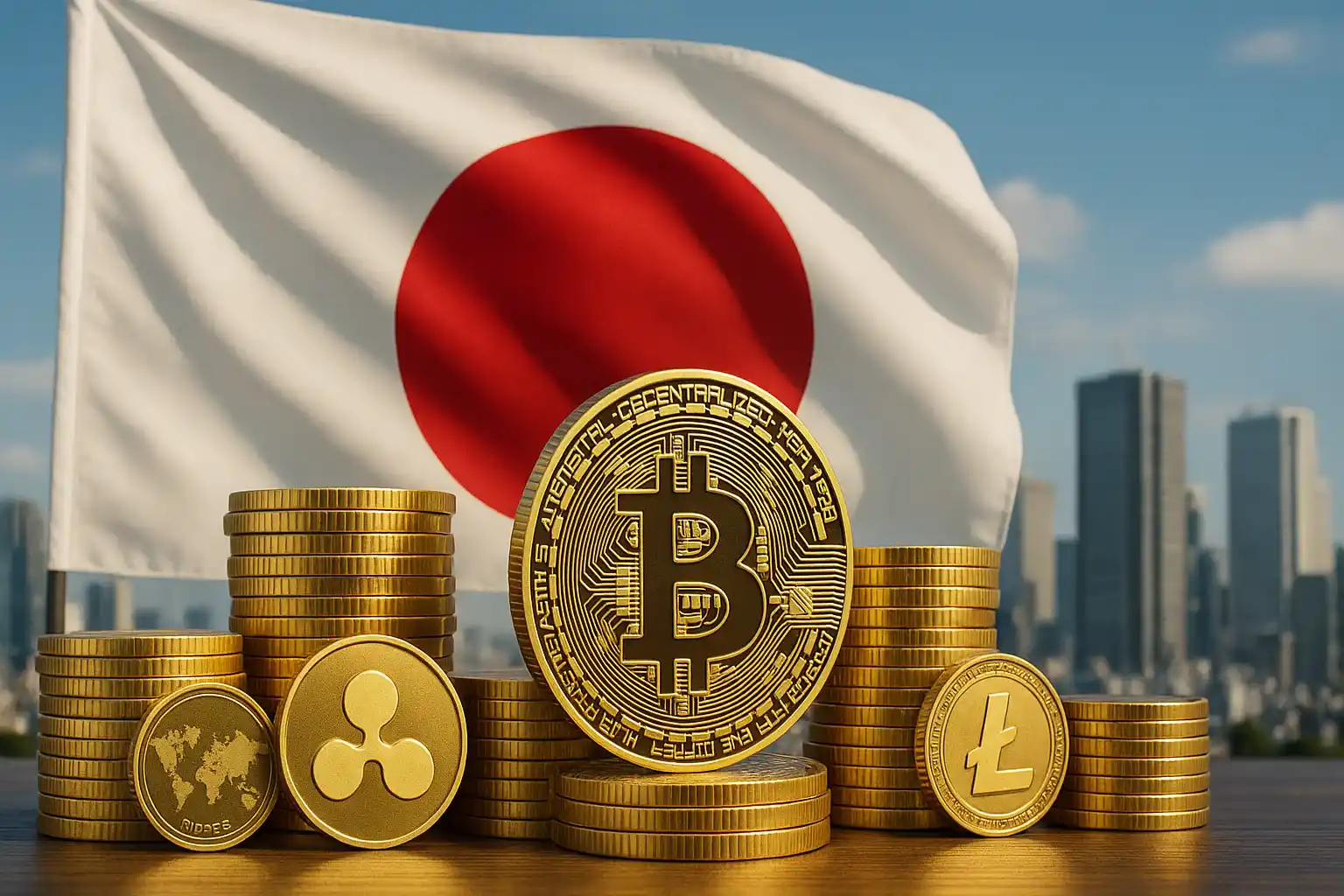
Japan has vaulted to the top of Asia-Pacific’s crypto adoption charts in 2025, outpacing India, South Korea, Indonesia, and Vietnam. Over the 12 months ending June, Japan recorded a 120 % increase in on-chain value received, according to a Chainalysis report — the largest growth among APAC’s major markets.
By contrast, growth in other markets during the same period ranged from 103 % in Indonesia, 100 % in South Korea, 99 % in India, to 55 % in Vietnam. This marked turnaround is particularly notable given Japan’s previously subdued crypto activity. Experts attribute the momentum to a trio of factors: regulatory reform, increasing stablecoin access, and shifting investor preferences toward altcoins.
Ready to level up your career? Join our expert-led Online courses in ACCA, HESI A2, ATI TEAS 7, HESI EXIT, NCLEX-RN, NCLEX-PN, and Financial Literacy. At Serrari Ed, we turn potential into achievement. Start your journey today!
Policy Reforms & Institutional Shifts Fuel Japan’s Growth
Regulatory modernization and stablecoin approval
One of the strongest catalysts behind Japan’s leap has been its policy overhaul. Historic restrictions on stablecoins are being relaxed, enabling exchanges to list tokens such as USDC and the first yen-pegged stablecoin, JPYC. These changes have opened new on- and off-ramp opportunities for retail and institutional participants alike.
The Cointelegraph analysis cites that Tokyo aims to align digital asset regulation more closely with securities law, introducing tax reforms and licensing regimes that provide clearer pathways for industry players. Meanwhile, Reuters reported that Japan’s Financial Services Agency (FSA) is considering amendments to classify crypto as regulated financial products — a shift that would bring insider-trading rules and improved oversight to the sector.
The role of macro timing
Japan’s lift also comes amid favorable global tailwinds. Chainalysis notes that legal reform expectations, combined with market rebounds globally in late 2024 (following U.S. election market movements), helped accelerate trading volumes. Japan’s policy changes provided a timely opening for capital inflows to shift from speculative surges into more structured growth.
The Chainalysis Geography of Crypto report also highlights that APAC overall saw on-chain value climb from about $81 billion monthly in mid-2022 to a peak near $244 billion in December 2024 — and though volumes have cooled, remain above $185 billion per month as of mid-2025. Japan’s 120 % year-on-year rise placed it at the front of this regional wave.
Stablecoins & Emerging Investor Behavior
Stablecoins as infrastructure
Stablecoins increasingly function as the plumbing of modern crypto usage: facilitating remittances, liquidity movements, hedging, and bridging gaps between traditional and digital finance. In Japan, the new policy flexibility has made stablecoins more accessible to domestic exchanges, creating fuel for uptake.
Altcoins over Bitcoin?
Interestingly, Japanese traders showed a distinct preference for XRP, which recorded $21.7 billion in JPY-based trading volume — eclipsing Bitcoin (~$9.6 billion) and Ethereum (~$4 billion) over the same period. Analysts link this to Ripple’s partnership with SBI Holdings and XRP’s positioning as a bridge token with real-world utility in payments and transfers.
That tilt toward altcoins — especially those perceived as interoperable or payments-friendly — reflects a more mature, diversified investor sentiment. Some are hedging away from pure store-of-value narratives and toward utility-driven value.
APAC Context: How Japan Compares
While Japan leads the growth percentage, the APAC region as a whole is shaping the global crypto landscape.
- India retains dominance in total on-chain activity, supported by remittances, grassroots adoption, fintech embedding (e.g. UPI), and domestic demand. Chainalysis ranked India No. 1 in its 2025 Global Adoption Index, across retail, institutional, and decentralized segments.
- South Korea has been propelled by stablecoin demand. Its KRW-backed stablecoin purchases reached $59 billion in the year through June 2025, reflecting strong utility-based trading. However, the market is under mounting regulatory pressure to tighten oversight and align with evolving policies.
- Indonesia and Vietnam continue to post strong growth, often from lower baselines, with crypto increasingly used in remittances, digital payments, entertainment, and savings.
- Countries like Pakistan also make the list, using stablecoins to hedge inflation and support freelancer payouts — evidence that APAC’s growth comes via multiple local use cases, not a single narrative.
Crowdfund Insider and other analysts underscore that APAC’s rise is not about copying the U.S. or European model; instead, it’s adapting crypto to regional financial needs.
Build the future you deserve. Get started with our top-tier Online courses: ACCA, HESI A2, ATI TEAS 7, HESI EXIT, NCLEX-RN, NCLEX-PN, and Financial Literacy. Let Serrari Ed guide your path to success. Enroll today.
Challenges & Risks Ahead
Regulatory balance & legalization complexity
Japan’s path is not without friction. The decision to classify crypto as financial products (as proposed by the FSA) will bring stricter disclosure, insider-trade rules, and compliance burdens. Critics worry this could stifle innovation if overly rigid. Likewise, Financial Times noted that Japan remains cautious about allowing spot crypto ETFs, constrained by high tax rates on crypto gains (up to 55 %) unless reclassified as capital gains (20 %).
Volatility & concentration
Heavy concentration in one altcoin (XRP) may exacerbate directional risk if market sentiment shifts. Also, trading volumes may remain sensitive to macro events, regulation, or global liquidity swings.
Security, fraud, and infrastructure strain
As adoption scales, threats from hacking, phishing, fraud syndicates, and exchange vulnerabilities intensify. Cases like the arrest of a syndicate stealing $15.1 million from Korean victims underscore that criminals follow the money.
Inclusion and access
Growth may be uneven. Rural, elderly, or lower-income segments may lag behind, fostering inequality in digital finance access. Infrastructure gaps (connectivity, mobile access) remain constraints.
Strategic Implications & Outlook
Institutional interest & capital flows
Japan’s renewed clarity and regulation may attract institutional entrants — hedge funds, asset managers, tokenization platforms — especially as the country positions itself as a regulated digital asset hub.
Stablecoin proliferation
Watch stablecoins like JPYC and USDC expand in Japan, facilitating liquidity flows not just domestically but regionally. As stablecoins settle deeper in payment rails, usage beyond speculation may increase.
Asia-Pacific leadership shift
With Japan’s leap, leadership in crypto adoption may decentralize: no longer dominated by India or South Korea alone. Rather, multiple nodes (Japan, India, Vietnam, Indonesia) may emerge as distinct growth centers, each with their own regulatory and usage ecosystems.
Regulatory experimentation
Japan’s ability to iterate regulation, adapt tax regimes, and align crypto with traditional finance may become a case study. If it avoids stifling rules while enforcing investor protection, it may be a blueprint for other advanced markets.
Conclusion
Japan’s 120 % growth in crypto adoption over the past year signals a seismic shift. By combining policy clarity, stablecoin expansion, and evolving investor behavior, the country has moved from quiet to catalytic in the APAC crypto landscape.
While challenges around regulation, risk, and infrastructure remain, Japan is now a real contender in crypto’s next frontier. If it manages its regulation well — supporting innovation while protecting users — it could set a standard for mature crypto markets in the years ahead.
Ready to take your career to the next level? Join our Online courses: ACCA, HESI A2, ATI TEAS 7 , HESI EXIT , NCLEX – RN and NCLEX – PN, Financial Literacy!🌟 Dive into a world of opportunities and empower yourself for success. Explore more at Serrari Ed and start your exciting journey today! ✨
Track GDP, Inflation and Central Bank rates for top African markets with Serrari’s comparator tool.
See today’s Treasury bonds and Money market funds movement across financial service providers in Kenya, using Serrari’s comparator tools.
Photo source: Google
By: Montel Kamau
Serrari Financial Analyst
2nd October, 2025