Key Takeaways
- The Republican-led House Rules Committee voted 8–4 late on Wednesday to advance President Trump’s $3.8 trillion tax‐and‐spending package, setting up pre-dawn votes on the House floor.
- The “big, beautiful bill” would extend and expand Trump’s 2017 tax cuts, introduce new breaks for tipped income and auto loans, eliminate many green‐energy subsidies and bolster defence and immigration enforcement funding.
- Offsetting measures include tightened eligibility for food stamps (SNAP) and Medicaid work requirements, which are projected to push an additional $3.8 trillion onto the national debt over ten years.
- Moody’s recent downgrade of the U.S. sovereign credit rating and weak demand at a $16 billion Treasury auction have exacerbated investor jitters about rising deficits.
- The bill’s passage in the House would trigger months of fraught negotiations in the Senate and heighten the stakes for the upcoming debt‐limit deadline this summer.
Procedural Milestone Sets Stage for Early-Morning Votes
Shortly before midnight in Washington, the 13-member House Rules Committee reconvened after a nearly 22-hour marathon session. By an 8–4 margin, including no Democratic support, the committee approved a package of amendments and procedural motions to bring President Trump’s signature legislation—dubbed the “big, beautiful bill”—to the House floor within hours (Reuters).
Under the expedited schedule, the full House is slated to begin debate in the pre-dawn hours of Thursday, with a first vote to open debate followed swiftly by the final passage vote. House Speaker Mike Johnson expressed confidence that the narrow 220–212 Republican majority would hold, telling reporters, “I believe we are going to land this airplane”.
Anatomy of the “Big, Beautiful Bill”
Tax Provisions
- Extension of 2017 cuts: All individual and corporate tax rates from the Trump administration’s 2017 Tax Cuts and Jobs Act would continue through 2031, reversing scheduled expirations under current law.
- New breaks for tipped workers: Employees earning income largely through tips (such as restaurant servers) would see an expanded credit on low-income portions of their wages.
- Auto loan deduction: Borrowers could deduct interest on new auto loans up to $60,000 in principal a measure pitched as relief for middle-class car buyers.
Spending Measures
- Military and border enforcement: Additional $150 billion over five years for the Department of Defense and $80 billion for Customs and Border Protection, in response to heightened security concerns.
- Energy subsidies: Complete phase-out of clean-energy tax credits for wind and solar generation, including retroactive claw backs on projects under construction—a move championed by oil-and-gas interests but decried by environmentalists.
Offsets and Cuts
- SNAP (food stamps): Stricter work requirements for able-bodied recipients, tightening eligibility and terminating benefits for non‐compliant adults under age 60.
- Medicaid: Instituting work requirements by end‐2026, two years ahead of current waiver programs, and penalising states that expand coverage beyond baseline levels.
- State and local tax (SALT) cap: Raising the $10,000 cap on SALT deductions to $15,000, but only for households earning below $200,000 annually—an attempt to recoup revenue while mollifying high-tax jurisdictions.
Together, the Congressional Budget Office (CBO) estimates these provisions will add $3.8 trillion to the federal debt over the next decade, compounding an existing debt load of $36.2 trillion (Reuters).
Intra-Party Divisions and Last-Minute Pressure
Despite unified Republican control, lawmakers remain deeply split over the extent of spending cuts. A faction of hardcore fiscal conservatives demanded steeper trims to domestic discretionary budgets—proposing a 15% cut across the board—before agreeing to lift the House rule to advance the bill (The Washington Post).
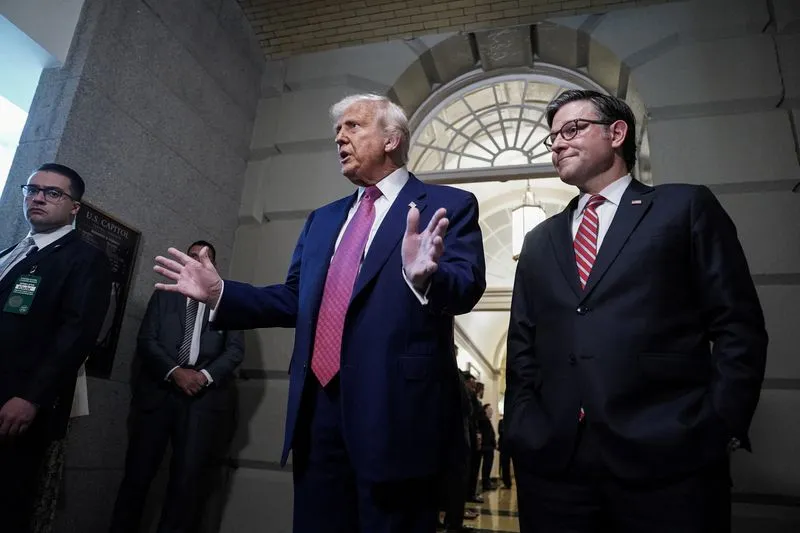
On Wednesday, a group of holdouts met with President Trump and Speaker Johnson, seeking assurances of future belt-tightening measures. Trump, who visited the Capitol to rally support, repeatedly invoked his “beautiful” branding for the package, calling it “the fairest, most magnificent tax plan this nation has ever seen” (Reuters).
Market Jitters: Bond Auctions and Credit Downgrade
Investor unease about ballooning deficits and policy uncertainty was on full display this week. On Wednesday, the U.S. Treasury struggled to place its $16 billion auction of 20-year bonds, which yielded 5.047%—its highest level since November 2023—and saw its weakest demand since February.
Meanwhile, Moody’s Investors Service last week stripped the United States of its top-tier Aaa rating, citing persistent fiscal deficits and a lack of credible deficit-reduction plans (Al Jazeera). The downgrade—unprecedented since 1919—has raised Treasury-borrowing costs and contributed to a recent uptick in long-term yields across global markets.
Democratic Opposition and Public Opinion
Democrats have launched a vigorous campaign to paint the bill as a giveaway to the wealthy at the expense of vulnerable Americans. Representative Jim McGovern (D-MA), ranking member of the Rules Committee, warned, “Republicans are kicking millions of Americans off their healthcare and snack benefits in order to finance tax cuts that will help billionaires”.
Representative Gwen Moore (D-WI) added on the House floor, “Cutting benefits means families will go hungry, farmers will suffer and healthcare costs will go up,” underscoring Democratic fears that tighter SNAP and Medicaid rules could hit low-income households hardes.
Public-opinion trackers reflect a mixed picture: Trump’s approval rating stands at 42%, with roughly half of voters opposing further deficit increases—even if they favour lower taxes—indicating tight political margins as Republicans eye the 2026 midterms.
The Debt-Limit Impasse Looms
With the federal debt clock ticking upward, lawmakers must address the statutory debt ceiling by early July to avert a catastrophic default. Treasury Secretary Janet Yellen has warned that passing this tax-and-spending package without accompanying deficit-reduction measures could precipitate a politically charged showdown over raising the debt limit.
Republican leaders have signalled they will tie any future debt-ceiling increase to spending caps and entitlement reforms—raising the prospect of an end-game gridlock reminiscent of the 2011 crisis that first prompted credit-rating downgrades.
What’s Next: The Senate and Beyond
Should the bill squeak through the House, it will land in the evenly divided Senate, where moderate and conservative Republicans alike have voiced trepidation. Even with Vice President Mike Pence casting tie-breaking votes, substantial changes—or outright rejection—are possible. Senate Minority Leader Mitch McConnell has emphasised his desire for bipartisan compromises rather than partisan all-or-nothing measures.
Assuming Senate passage, the final package would head back to the House for any conference‐committee adjustments. Only then could it reach President Trump’s desk—ironically delaying many of its tax breaks until 2026 or 2027 as Congress negotiates offsets.
Broader Economic Implications
Interest rates and inflation expectations are likely to be the immediate barometers of market response. Federal Reserve officials have signalled caution: with core inflation still above the Fed’s 2% target and elevated Treasury yields, officials have pushed back against expectations for imminent rate cuts.
Longer term, the bill’s trajectory could influence dollar strength, capital-flow dynamics, and emerging-market financing conditions. Economists warn that unchecked deficit growth—projected to push the debt-to-GDP ratio above 110% by 2030—could crowd out private investment and slow potential growth.
Historical Context: Tax Cuts and Debt Dynamics
The United States has periodically used tax cuts to stimulate growth, most notably under Presidents Kennedy (1964), Reagan (1981) and George W. Bush (2001). While each episode produced short-term growth spurts, deficit expansion often followed, leading to subsequent tax increases or spending caps in later decades.
Analysts contend that without credible offsets—such as entitlement-reform packages or revenue-raisers like broadened tax bases—this latest effort risks repeating past cycles of “tax cut, debt spike, tax hike”, leaving future generations to bear the burden.
Conclusion
As the House prepares for its early-morning votes, President Trump’s $3.8 trillion tax and spending bill represents a high-stakes gamble on the future trajectory of U.S. fiscal policy. The package’s extension of popular tax cuts is counterbalanced by stringent cuts to social programs, setting up a fundamental debate over the social compact and the nation’s long-term economic health.
Investor nerves—already frayed by Moody’s downgrade and weak Treasury auctions—are focused on whether Congress can reconcile its internal divisions and avert a debt-limit crisis this summer. In the coming weeks, Washington will see high-wire negotiations not just over tax code and welfare rolls, but over the fundamental question of how to balance growth, equity and sustainability in America’s fiscal framework.
Ready to take your career to the next level? Join our dynamic courses: ACCA, HESI A2, ATI TEAS 7 , HESI EXIT , NCLEX – RN and NCLEX – PN, Financial Literacy!🌟 Dive into a world of opportunities and empower yourself for success. Explore more at Serrari Ed and start your exciting journey today! ✨
photo source: Google
By: Montel Kamau
Serrari Financial Analyst
22nd May, 2025