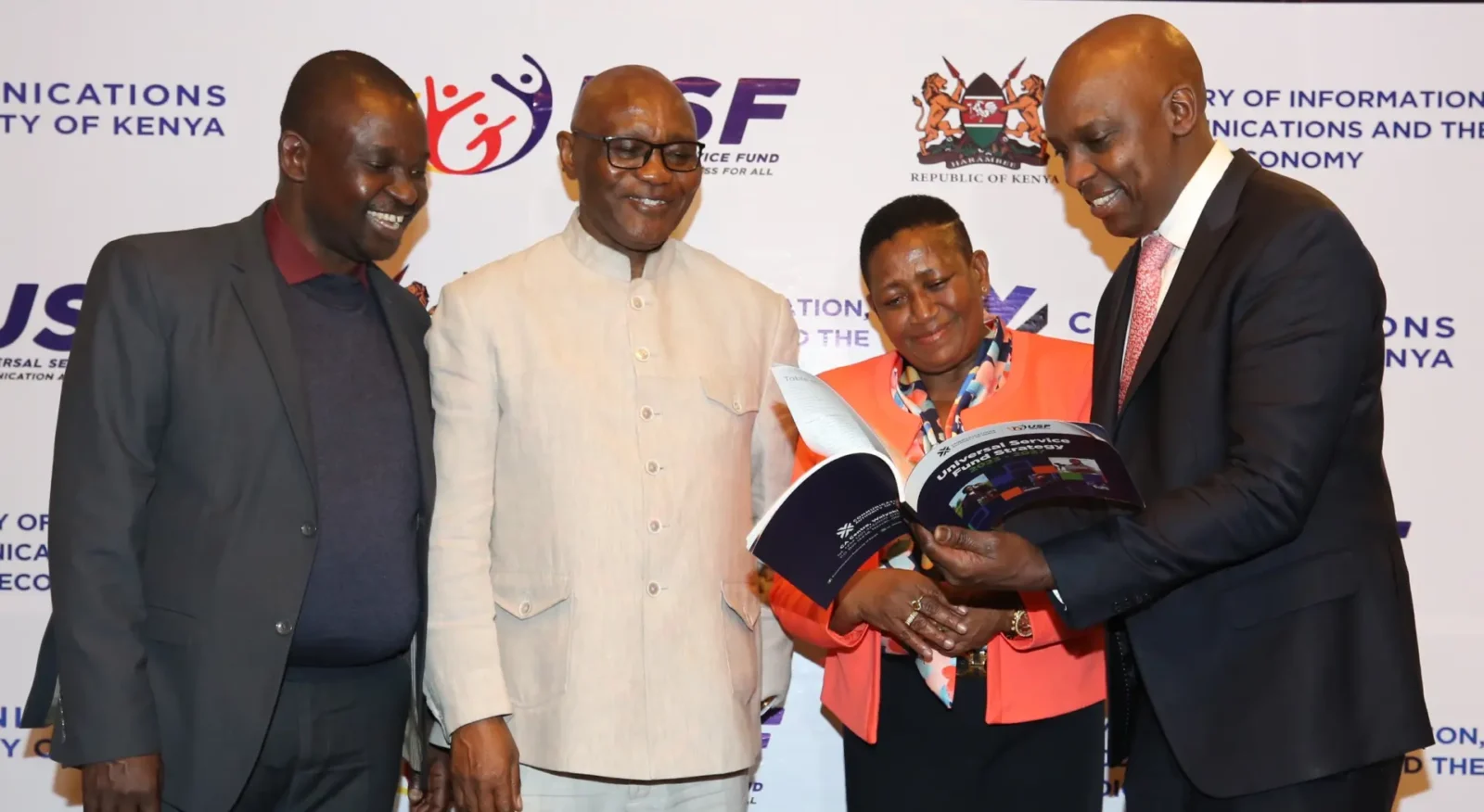
The Communications Authority of Kenya (CA) has unveiled an ambitious KSh 40 billion (approximately US $270 million) Universal Service Fund (USF) Strategy for 2023–2027, aimed at extending information and communications technology (ICT) services to every corner of the country—urban and rural—by 2027. Director General David Mugonyi officially launched the plan on 20 May during a high-profile ceremony in Nairobi, emphasizing the Authority’s determination to bridge the digital divide and foster inclusive economic growth.
Strategy Overview and Rationale
At its core, the USF Strategy 2023–2027 seeks to close the gap between Kenya’s current ICT footprint—approximately 48 percent national internet penetration—and the universal access required to drive 21st-century development goals (Twiva). By pooling contributions from telecom operators and private-sector partners, the Fund will underwrite targeted infrastructure projects, digital literacy programmes and affordable access initiatives in underserved areas.
The Digital Divide in Kenya: Stark Disparities
Despite remarkable progress over the last decade, Kenya’s digital landscape remains uneven. Urban centres such as Nairobi and Mombasa boast internet penetration rates exceeding 60 percent, while rural communities linger at just 25 percent (KICTANet). Even within connected areas, computer usage per household is as low as 10 percent, and overall internet usage stands at 23 percent (The Eastleigh Voice News).
Gender and regional disparities further compound these figures: nationally, 37.8 percent of men are online compared to 32.2 percent of women, a gap that widens sharply in rural counties (KICTANet). These inequalities limit economic opportunities, impede access to critical services such as e-health and e-education, and curtail Kenya’s potential as a digital innovation hub.
Key Pillars of the USF Strategy
The USF 2023–2027 Strategy is structured around four interlocking pillars:
- Infrastructure Deployment
- Digital Superhighway: Lay 100,000 km of fibre-optic cable nationwide, including 2,500 km in 19 unserved counties at a KSh 5 billion investment, to strengthen the national backbone (ca.go.ke).
- Fibre-to-Last-Mile: Leverage Kenya Power’s network to extend last-mile fibre access to 3,800 public institutions—schools, hospitals and government offices—under a KSh 5 billion partnership (The Eastleigh Voice News).
- Digital Superhighway: Lay 100,000 km of fibre-optic cable nationwide, including 2,500 km in 19 unserved counties at a KSh 5 billion investment, to strengthen the national backbone (ca.go.ke).
- Community Access and Hubs
- Establish 1,450 ICT hubs—one per ward—with support from the ICT Authority and Konza Technopolis Development Authority (KoTDA). The hubs will provide shared computers, free Wi-Fi and digital-skills training, backed by a KSh 2.8 billion allocation (The Eastleigh Voice News).
- Roll out 25,000 public Wi-Fi hotspots in peri-urban and rural markets, enhancing affordability and convenience (ca.go.ke).
- Establish 1,450 ICT hubs—one per ward—with support from the ICT Authority and Konza Technopolis Development Authority (KoTDA). The hubs will provide shared computers, free Wi-Fi and digital-skills training, backed by a KSh 2.8 billion allocation (The Eastleigh Voice News).
- Digital Literacy and Innovation
- Launch nationwide digital literacy campaigns, targeting youth, women and older adults, to raise ICT utilisation from below 30 percent to at least 60 percent of the population by 2027 (KICTANet).
- Partner with tech hubs in Konza (“Silicon Savannah”) to incubate local startups, thereby creating content and services tailored to rural needs (konza.go.ke).
- Launch nationwide digital literacy campaigns, targeting youth, women and older adults, to raise ICT utilisation from below 30 percent to at least 60 percent of the population by 2027 (KICTANet).
- Policy, Regulation and Funding
- Introduce incentives—such as tax breaks and reduced spectrum fees—for operators that extend coverage to marginalised areas.
- Ensure transparent, timely disbursement of USF grants through an online dashboard, enabling civil-society oversight.
- Conduct annual public consultations to align USF priorities with evolving market needs, building on insights from the 2022 draft strategy feedback (KICTANet).
- Introduce incentives—such as tax breaks and reduced spectrum fees—for operators that extend coverage to marginalised areas.
Investment Breakdown and Funding Gaps
While the Sh 40 billion budget underscores CA’s commitment, independent analysts warn of funding shortfalls. Techweez reports that, as of May 2025, only Sh 28 billion has been earmarked or secured, leaving a looming Sh 12 billion gap (Techweez). The Authority is actively engaging mobile network operators—Safaricom, Airtel and Telkom Kenya—to fulfil their USF levy obligations and exploring donor partnerships to bridge the deficit.
Progress to Date: Foundations for Success
Since its operationalisation in 2014, the USF has delivered tangible outcomes:
- 800,000 additional Kenyans across 156 sub-locations gained basic mobile connectivity by 2024 (The Eastleigh Voice News).
- 2,100 km of fibre has already been laid under the Digital Superhighway, linking five new counties—Wajir, Mandera, Turkana, Samburu and West Pokot—to the national network (The Eastleigh Voice News).
- 47 Centres of Excellence established, equipped with advanced ICT labs to serve as regional training hubs.
These early successes have helped inform the 2023–2027 Strategy, ensuring future investments build on proven models and lessons learned.
Lessons from Global Peers
Kenya’s ambitious targets align with continental benchmarks. In neighboring Rwanda, universal broadband goals spurred over US $150 million in infrastructure investment and raised rural coverage from 20 percent to 65 percent between 2018 and 2024 (Tremhost). South Africa’s Digital Infrastructure Strategy similarly prioritises public-private partnerships to deploy last-mile fibre, resulting in 70 percent national coverage by 2023 (Tremhost).
These case studies highlight critical success factors such as streamlined licensing, shared-infrastructure models and sustained community engagement that Kenya’s USF Strategy has incorporated.
Challenges Ahead: Usage vs. Coverage
While infrastructure is expanding, utilisation remains a hurdle. Current broadband subscriptions represent just 48 percent of the population, with data-affordability cited as a key barrier (Twiva). Charles Juma of the UK Digital Access Programme warns that low utilisation—below 30 percent—threatens the economic viability of full coverage (The Eastleigh Voice News).
To counter this, CA plans targeted subsidies for low-income households, collaboration with device-makers for affordable smartphones, and digital-media initiatives that demonstrate the livelihood value of connectivity—such as e-agriculture platforms and telemedicine services.
Multi-Stakeholder Partnerships
Success hinges on cohesive action across government, industry and civil society:
- Government Ministries: The Ministry of ICT and Digital Economy will align its Digital Masterplan (2022–2032) with USF projects, ensuring consistency with national development priorities (ca.go.ke).
- Private Sector: Telecom operators will be incentivized to co-invest in shared towers and fibre ducts, reducing CapEx burdens on the USF.
- Development Partners: Agencies such as the World Bank and African Development Bank are evaluating lines of credit to back USF initiatives, particularly for high-impact health-and-education connectivity projects.
- Community Organisations: Local NGOs and digital-rights groups will monitor implementation, conduct digital-literacy training and collect grassroots feedback to refine service delivery.
Monitoring, Evaluation and Transparency
To maintain public trust, CA will publish quarterly progress reports, featuring:
- Kilometres of fibre deployed vs. targets
- Number of ICT hubs and hotspots activated
- Uptake statistics—subscriptions, data traffic, community-training attendance
- Financial audits and disbursement timelines
An interactive dashboard, set to launch in Q3 2025, will enable Kenyans to track real-time progress down to ward level, fostering accountability and enabling course correction where needed.
Looking Forward: The Road to 2027
Over the next two years, key milestones include:
- End-2025: Complete fibre rollout in 10 additional counties and activate 500 ICT hubs.
- Mid-2026: Achieve 70 percent rural broadband coverage and 40 percent national ICT-service utilisation.
- End-2027: Reach 100 percent geographic coverage, with utilisation targets of at least 60 percent, alongside robust digital-skills indicators.
If these targets are met, Kenya will not only bridge its own digital divide but also reinforce its position as East Africa’s leading digital economy, driving innovation, job creation and social inclusion.
Conclusion: Towards an Inclusive Digital Future
The CA’s Sh 40 billion USF Strategy for 2023–2027 is both bold and necessary. By tackling infrastructure gaps, fostering affordability and championing digital literacy, Kenya is laying the groundwork for a more equitable and prosperous society. As DG Mugonyi aptly put it, “Connectivity is not just about cables and towers; it’s about unlocking human potential and creating opportunities for every Kenyan.”
With sustained political will, multi-stakeholder collaboration and transparent monitoring, Kenya’s journey toward 100 percent rural ICT coverage by 2027 stands poised to become a beacon for digital inclusion across the continent.
Ready to take your career to the next level? Join our dynamic courses: ACCA, HESI A2, ATI TEAS 7 , HESI EXIT , NCLEX – RN and NCLEX – PN, Financial Literacy!🌟 Dive into a world of opportunities and empower yourself for success. Explore more at Serrari Ed and start your exciting journey today! ✨
photo source: Google
By: Montel Kamau
Serrari Financial Analyst
21th May, 2025