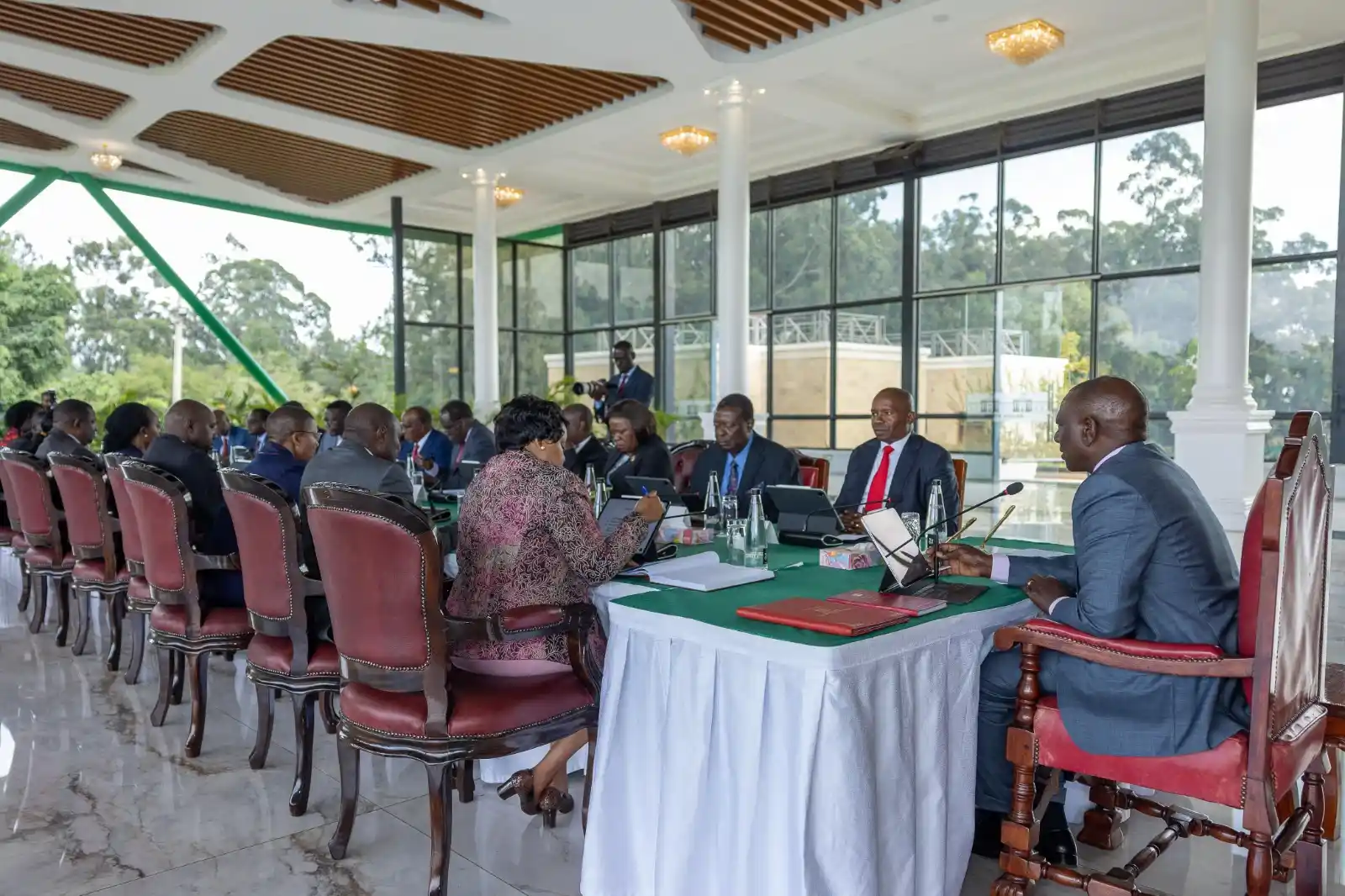
In a decisive move to rein in public spending and inject fresh momentum into Kenya’s economy, President William Ruto presided over a Cabinet meeting at State House, Nairobi, that approved the Finance Bill, 2025. The legislation, which now proceeds to Parliament, aims to sharpen tax administration, seal revenue leakages, and unlock growth—particularly for small businesses and retirees—while narrowing the fiscal deficit to a targeted 4.5 percent of GDP in the coming financial year.
Balancing the books without breaking backs
Kenya enters the 2025/26 budget cycle with familiar challenges: debt servicing now consumes more than 30 percent of government revenues, and public borrowing has pushed the debt-to-GDP ratio above 68 percent. At the same time, the economy is expected to grow at around 5.1 percent this year, buoyed by rebounding agriculture, resilient tourism, and a vibrant diaspora remittance inflow. The Finance Bill, 2025, seeks to harness that momentum by tightening loopholes—rather than piling on new taxes—and streamlining the system so that every shilling collected goes to visible public goods such as health, education, and infrastructure.
The Bill’s architects emphasize surgical precision: simplifying refund processes that have in the past been exploited through inflated claims, rationalizing exemptions that carved away billions in tax expenditures, and modernizing digital filing and compliance to cut red tape. By focusing on efficiency and enforcement, the government plans to raise an additional Ksh 75 billion in net revenue without raising headline rates—a crucial distinction as ordinary Kenyans grapple with rising living costs.
Empowering small enterprises with timely relief
One of the most applauded provisions allows small and medium-sized enterprises (SMEs) to fully deduct the cost of tools, equipment, and machinery in the year of purchase, rather than depreciating them over several accounting periods. In workshops and mom-and-pop stores across Nairobi, Mombasa, and Kisumu, owners breathed a sigh of relief at the prospect of improving cash flow.
Take Jane Mwende, who runs a small textile workshop on the outskirts of Nakuru. Under the old regime, her profits were burdened by slow tax relief on a new embroidery machine. Now, she can deduct its entire cost against this year’s income, freeing up working capital for raw materials and wages. “This change means we can expand our staff and take on larger orders without waiting years to see the benefit on our tax bill,” she says.
That same logic underpins exemptions for start-up businesses in designated special economic zones, where full expensing of initial capital outlays should accelerate the growth of hubs focused on light manufacturing, agribusiness processing, and digital services.
A welcome gift for retirees
Perhaps no measure drew as much applause among Kenya’s silver generation as the decision to exempt all gratuity payments from tax. Whether from public or private pension schemes, lump-sum benefits will now pass to retirees untaxed, restoring purchasing power for those who see their monthly pensions eroded by living costs.
Seventy-three-year-old Mr. Lucas Otieno, a retired primary school headteacher from Kisii County, describes the change as “a blessing.” Having waited decades for his gratuity, he now plans to refurbish his small coffee farm and help his eight grandchildren pay school fees. “Every shilling counts when you’re on a fixed pension,” he notes. This exemption is expected to cost the Exchequer around Ksh 18 billion in foregone revenue, but officials argue the social payoff—reduced hardship and boosted rural demand—will more than justify it.
Automation of PAYE reliefs
Kenyan workers have long endured lengthy hassles applying to the Kenya Revenue Authority for overpaid Pay-As-You-Earn refunds. Under the new Bill, employers will automatically apply every available relief—such as child allowances, insurance-premium deductions, and mortgage-interest relief—at source. Salaried employees can therefore expect smoother payroll calculations, quicker net-pay improvements, and no need to chase refunds months later.
Businesses welcome this move as a way to reduce administrative burdens. “We spend countless hours reconciling employee tax reconciliations at year end,” explains Jane Kariuki, HR manager at a mid-sized logistics firm in Eldoret. “Automating reliefs frees us to focus on productivity rather than paperwork.”
Streamlining the tax code: closing loopholes and curbing abuse
Beyond taxpayer-friendly measures, the Bill tackles sophisticated avoidance schemes. It tightens thin-capitalization rules to limit excessive interest deductions in multinational group financing arrangements; raises the minimum withholding tax on dividends and royalties paid to non-residents; and updates transfer-pricing regulations to align with global best practices. These amendments are designed to preserve Kenya’s competitive tax rates while ensuring that large corporations and cross-border investors pay their fair share.
To accelerate processing, the Bill introduces tighter timelines and digital-monitoring thresholds for tax-refund approvals. Inflated VAT and import-duty rebate claims will now require electronic matching of purchase invoices, import manifests and customs declarations, leveraging the Kenya TradeNet portal. Early estimates suggest that streamlined digital audits could recover up to Ksh 12 billion annually.
Reinforcing BETA’s bottom-up vision
Cabinet memos make clear that these fiscal measures support the Bottom-Up Economic Transformation Agenda (BETA)—President Ruto’s flagship blueprint for inclusive growth. By plugging leakages, the Bill aims to free resources for targeted interventions in agriculture, health, education and rural infrastructure. Funds saved through tighter refund oversight will top up farm-input subsidies, expand primary-school feeding programmes, and boost community health worker networks in remote counties.
In tandem, the Public Finance Management (Amendment) Bill—also approved this week—mandates the creation of County Emergency Funds. Allocated at three percent of each county’s equitable share, these reserves will finance drought relief, disease outbreaks or flood-response efforts without waiting for national disbursements. Local officials applaud this change as a way to build resilience at the grassroots and avert ad-hoc crisis spending.
Bolstering judicial independence and healthcare infrastructure
The Cabinet additionally endorsed a Judges Retirement Benefits Bill, overhauling pension provisions to attract and retain top legal talent. By adjusting age-of-retirement thresholds and severance packages, the proposal seeks to strengthen the judiciary’s ability to enforce contracts and safeguard property rights—key elements in building investor confidence.
On the healthcare front, the administration greenlit major facility upgrades in Bungoma and Kericho counties. Bungoma’s referral hospital will receive a new wing for maternal and neonatal care, complete with solar power backup, while Kericho’s district hospital is set to get a state-of-the-art laboratory and digital radiography unit. These projects collectively represent a Ksh 8.5 billion investment, co-financed by the national government and county co-funding, and are slated for completion by mid-2026.
Kenya’s expanding diplomatic footprint
Beyond finance and development, the Cabinet signaled its intent to establish a Consulate General in Port-au-Prince, Haiti. This diplomatic outreach reflects Kenya’s growing role on the global stage and its commitment to supporting stability in fragile states. The anticipated mission will focus on consular services for Kenyans abroad, capacity-building initiatives in Haiti’s public sector, and expanded cooperation on renewable-energy and water-management projects.
Learning from past missteps: the fallout of Finance Bill 2024
The 2024 Finance Bill, which proposed broad tax hikes, ignited youth-led protests that culminated in a dramatic storming of Parliament on June 25. With quotas on mobile money transactions and increases in fuel levies, the previous draft was widely criticized as heavy-handed. President Ruto ultimately withdrew it, vowing to recalibrate with a more balanced approach.
This year’s Bill reflects those lessons. By focusing on enforcement and loophole-closing instead of raising headline rates, the government hopes to avoid the political backlash of last year’s proposals. Economic analysts note that fiscal consolidation achieved through smarter tax administration is less likely to provoke public unrest than broad-based tax increases.
Stakeholder reactions: cautious optimism
Business associations greeted the Cabinet’s approval with guarded approval. The Kenya National Chamber of Commerce welcomed the focus on efficiency and small-business relief, while the Federation of Kenya Employers noted that the automatic PAYE relief and tool-expensing measures would support job creation. Rural cooperatives, meanwhile, urged swift implementation of the County Emergency Fund provisions to bolster agro-processing ventures during dry spells.
Opposition parties and civil-society groups have pledged to scrutinize the Bill in Parliament. Some lawmakers question whether projected revenue gains are realistically achievable without additional enforcement capacity at the tax authority. Transparency advocates are calling for quarterly public reporting on loophole-plugging results and the reallocation of reclaimed funds to priority social sectors.
The parliamentary marathon ahead
As the Finance Bill travels to the National Assembly and Senate, lawmakers will have the opportunity to propose amendments and hear testimonies from the Kenya Revenue Authority, the Ministry of Finance, private-sector representatives and civil-society delegates. Parliamentary agencies estimate that the first reading could take place in mid-May, with debates stretching into June. Ultimately, the Bill must secure presidential assent before the start of the 2025/26 fiscal year on July 1.
Given the improved consultations this time around—industry forums, county-level public participation exercises and targeted stakeholder workshops—the administration is optimistic about smooth passage. Yet the pressure points are clear: ensuring that KRA is adequately resourced to enforce new rules, confirming that the automatic reliefs function seamlessly in payroll systems, and verifying that small businesses can access expensing provisions without onerous documentation.
Looking ahead: a test of delivery
Approving the Finance Bill, 2025, is only the opening chapter in Kenya’s quest to live within its means while spurring bottom-up growth. In practice, success will hinge on swift operational roll-out at KRA, robust county-level management of emergency funds, and transparent tracking of social impact. If executed well, the Bill could unlock tens of billions in additional revenues, catalyze investment in rural areas, and strengthen the social safety net for retirees and small-business owners.
For Kenyans like Mwende and Otieno, the proof will arrive in bank statements and renovated classrooms. For the wider economy, the measure of success will be in steady growth, a stable currency, and reduced reliance on debt markets. As Parliament takes up the Bill, all eyes will be on whether Nairobi can turn legislative ambition into tangible benefits for ordinary citizens—and usher in a new era of fiscal discipline without stifling the entrepreneurial spirit.
Ready to take your career to the next level? Join our dynamic courses: ACCA, HESI A2, ATI TEAS 7 , HESI EXIT , NCLEX – RN and NCLEX – PN, Financial Literacy!🌟 Dive into a world of opportunities and empower yourself for success. Explore more at Serrari Ed and start your exciting journey today! ✨
Photo source: Google
By: Montel Kamau
Serrari Financial Analyst
30th April, 2025