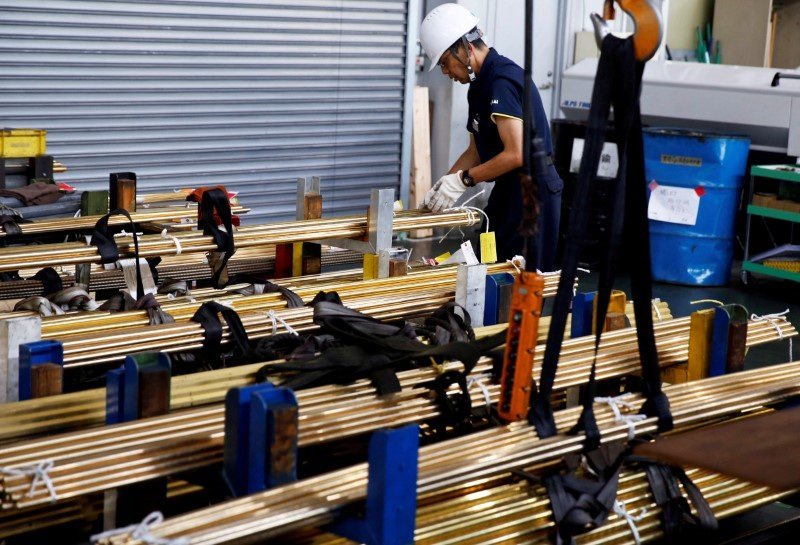
Japan’s economic landscape continues to reflect contrasting fortunes between its manufacturing and services sectors, with December marking the sixth consecutive month of factory contraction, according to the au Jibun Bank Flash Purchasing Managers’ Index (PMI). While manufacturing shrank further, the services sector showed resilience, pointing to an economy increasingly dependent on service-driven growth.
Manufacturing PMI Drops to 49.5
The manufacturing PMI declined to 49.5 in December, compared to 49.0 in November, staying below the critical 50-point threshold that separates contraction from expansion since June. This slump highlights ongoing challenges, including weak global demand, rising input costs, and slowing exports.
Key Issues in the Manufacturing Sector:
- Declining New Orders: Goods producers faced sharper reductions in orders, reflecting the softening global demand for Japanese exports. Key industries such as automotive and electronics have been particularly affected by weakened demand from major markets, including the United States and China.
- Cost Pressures and Inflation: Input costs climbed at the fastest rate in four months due to rising energy and raw material prices. Output prices also surged to their highest level since July, putting additional pressure on manufacturers.
- Weak Business Confidence: Sentiment in the manufacturing sector dropped to its lowest level since May 2022. Concerns over global economic uncertainties and geopolitical tensions are affecting forward-looking confidence.
Services PMI Shows Modest Growth
The services PMI, in contrast, increased to 51.4 in December from 50.5 in November, marking its highest level in four months. This indicates modest expansion, driven by recovering domestic demand, particularly in sectors such as hospitality and transportation.
Challenges in Services:
- Labour Shortages: Companies reported difficulties in hiring enough staff, which could hinder sustained growth.
- Rising Costs: Input costs in the services sector rose at their fastest pace in eight months, forcing firms to raise prices.
Composite PMI at 50.8
The composite PMI, combining both manufacturing and services activity, rose to 50.8 in December from 50.1 in November. While this points to marginal expansion, the growth is largely reliant on the services sector’s performance, highlighting the uneven recovery across Japan’s economy.
Economic Context: Bank of Japan Tankan Survey
The Bank of Japan’s quarterly Tankan survey released last week offers additional insights:
- Sentiment among large manufacturers improved slightly in the three months ending December, buoyed by stronger demand for renewable energy and healthcare products.
- Non-manufacturing firms remained optimistic, supported by robust domestic spending.
- Looking ahead, businesses expect tougher conditions due to potential global trade disruptions and uncertainties surrounding the U.S. tariff policies under President-elect Donald Trump.
Factors Influencing Japan’s Economic Landscape
- Global Slowdown: The slowdown in major economies, including the U.S., China, and the EU, is directly affecting Japanese exports, particularly machinery and automobiles.
- Rising Costs: The depreciation of the yen has inflated import costs, exacerbating inflationary pressures.
- Resilient Domestic Demand: Domestic spending, bolstered by government stimulus measures, is a bright spot in Japan’s economy, particularly in the services sector.
- Geopolitical Uncertainty: Rising tensions in the Asia-Pacific region and shifts in global trade policies add to the challenges facing Japan’s export-driven industries.
Policy Response and Outlook
To support the economy, the Bank of Japan (BOJ) has maintained its ultra-loose monetary policy. However, growing inflationary pressures have raised concerns about potential adjustments to its yield curve control policy in 2024. The government has also announced additional fiscal stimulus, focusing on energy subsidies and support for small businesses.
Analysts predict that Japan’s economic recovery will remain uneven, with the services sector likely to continue driving growth in the short term. However, a broader recovery will depend on stabilizing global demand, addressing labour market challenges, and managing inflationary pressures effectively.
Conclusion
Japan’s sixth consecutive month of factory contraction underscores the persistent challenges in its manufacturing sector, even as the services sector provides a glimmer of hope. Balancing these contrasting dynamics will be key to ensuring sustainable growth for Asia’s second-largest economy.
Ready to take your career to the next level? Join our dynamic courses: ACCA, HESI A2, ATI TEAS 7 , HESI EXIT and NCLEX – RN !🌟 Dive into a world of opportunities and empower yourself for success. Explore more at Serrari Ed and start your exciting journey today! ✨
photo source: Google
By: Montel Kamau
Serrari Financial Analyst
16th December, 2024