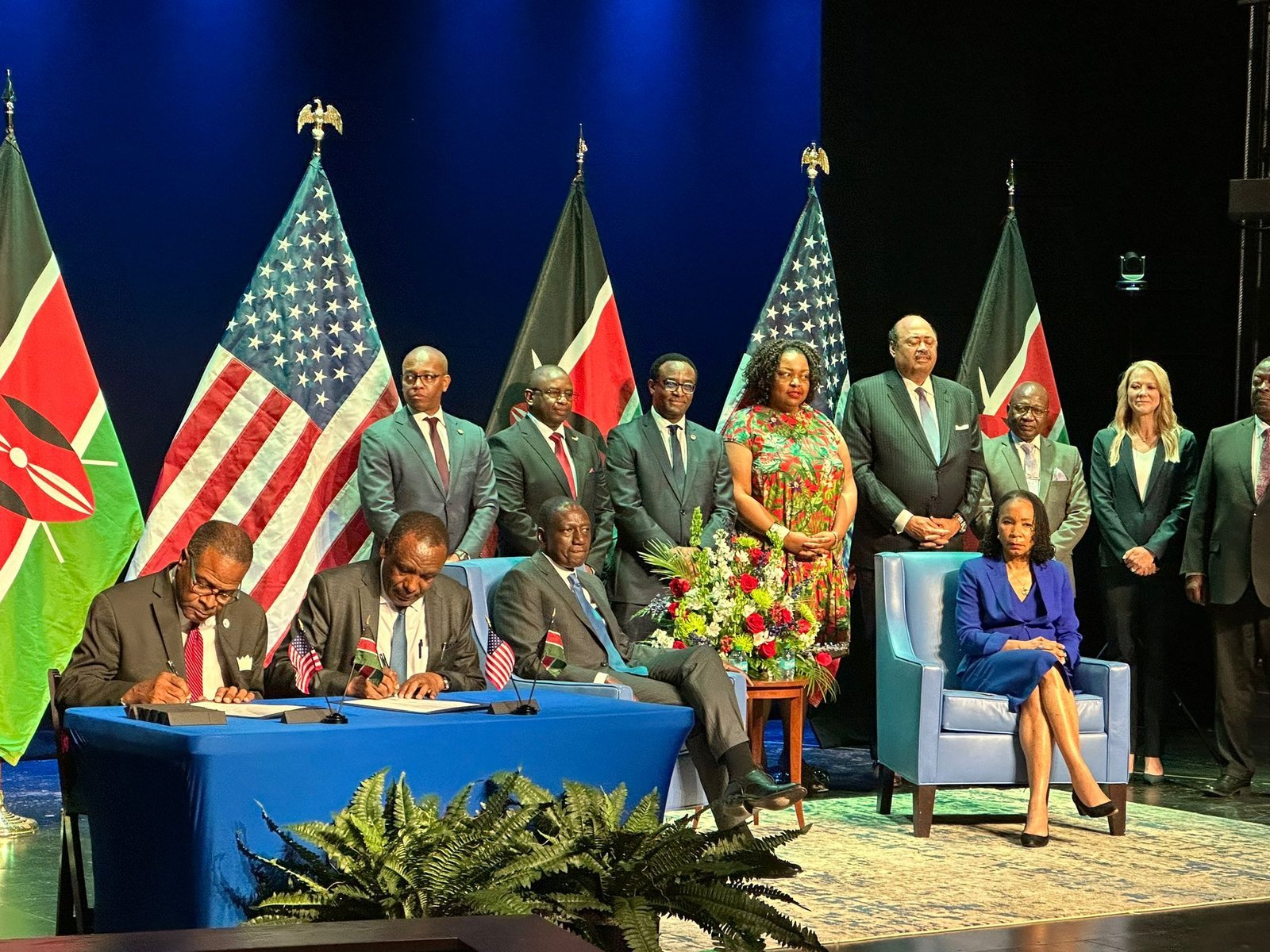
In a significant stride toward fostering innovation and economic growth, the United States and Kenya have formalized a pioneering Framework for Cooperation aimed at advancing STEM (Science, Technology, Engineering, and Mathematics) education.
During Kenyan President William Ruto’s State Visit to the United States, USAID Counselor Clinton White and Kenyan Prime Cabinet Secretary Wycliffe Musalia Mudavadi joined forces to sign the Enhancing STEM Education for Economic Development Framework for Cooperation. The ceremony, held at Spelman College in Atlanta, served as a pivotal moment for discussions centering on higher education investments and the transformative potential of STEM education for Kenya’s economy.
Highlighting their commitment to Kenya’s educational landscape, USAID announced a substantial investment of nearly $32 million. This investment encompasses a diverse array of initiatives, including support for the Edtech Africa initiative—a collaborative venture bridging Historically Black Colleges and Universities (HBCUs), the Open University of Kenya, Mastercard, and Microsoft. Additionally, a groundbreaking $6.5 million project aims to align STEM graduates with burgeoning sectors such as information technology, textiles, and pharmaceuticals. Complementing these endeavors is a $24.5 million program focused on early grade literacy, ensuring a strong foundation for higher education success.
Commending the enduring bilateral relationship between the United States and Kenya, a nod was made to the historic Kennedy-era assistance, symbolized by the iconic student airlift. Embracing this legacy, the U.S. Department of State unveiled the Kennedy-Mboya Partnerships—a forward-looking scholarship program endowed with $3.3 million, aimed at nurturing the next generation of Kenyan scientists, researchers, and engineers, with a distinct focus on STEM disciplines.
Anticipating a future marked by innovation and prosperity, USAID envisions the Framework for Cooperation as a catalyst for establishing robust linkages, exchange programs, and strategic partnerships, thereby enhancing the STEM, advanced manufacturing, and ICT capabilities of Kenyan higher education institutions. Noteworthy commitments from stakeholders such as Microsoft and the Mastercard Foundation underscore a collective dedication to fostering mutual capacity building in STEM-related fields.
This groundbreaking partnership reflects the United States’ steadfast commitment to Kenya’s journey as a hub of innovation and progress within the region. By empowering a new cohort of visionary leaders through cutting-edge STEM education, this collaborative effort is poised to propel Kenya’s economic development and cultivate a culture of innovation with far-reaching impact.
Photo Source: Google
By: Montel Kamau
Serrari Financial Analyst
23rd May, 2024