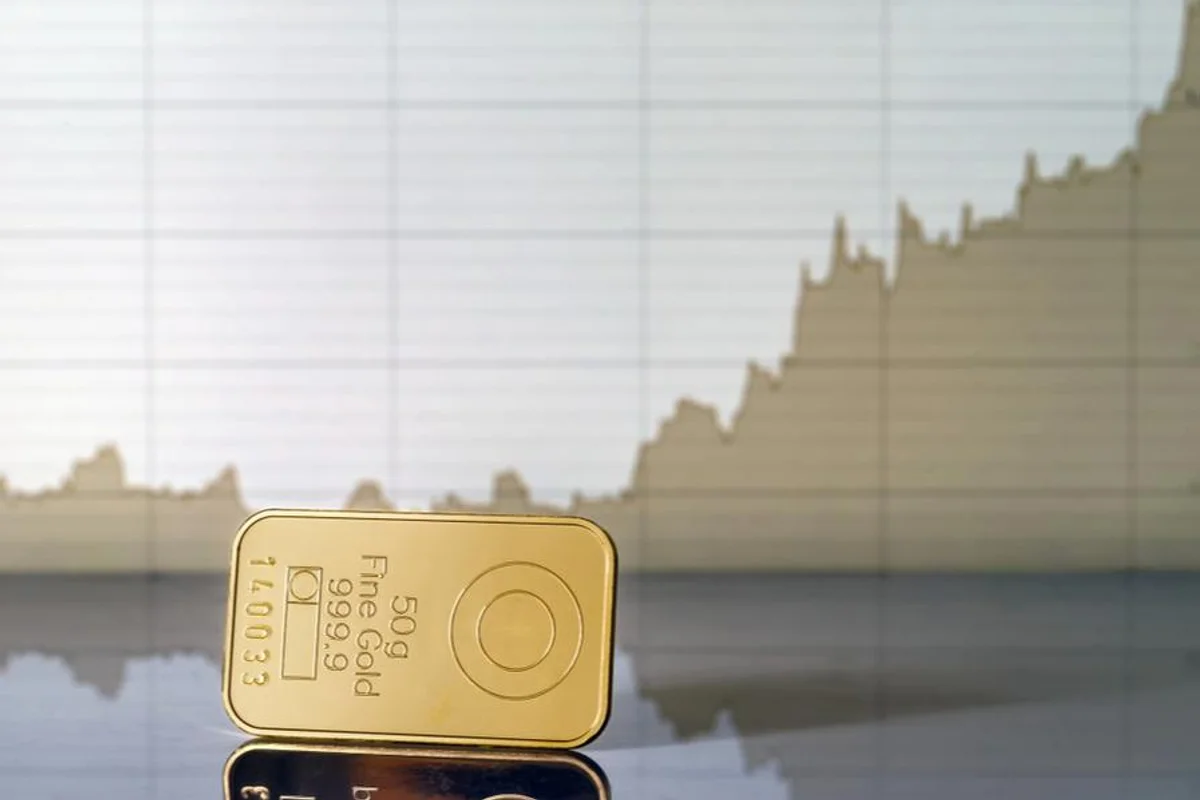
In recent weeks, gold prices have witnessed a significant rally, with the ongoing Hamas-Israel conflict playing a crucial role in highlighting gold’s status as a safe-haven asset and its intriguing divergence from the typical relationship with US Treasuries. As investors seek refuge amid geopolitical and market uncertainty, the precious metal’s value has soared by as much as 10 percent to $1,996 per troy ounce, marking a five-month high.
The escalation of hostilities in the Middle East, specifically the attacks launched by Hamas on Israel, has intensified the demand for gold. This surge is primarily driven by gold’s reputation as a store of value during times of global unrest and economic instability.
Nicky Shiels, a metals strategist at MKS Pamp, a Swiss precious metals refiner and trader, emphasized, “It’s the geopolitical risk premium that has come in for gold.” The turmoil in the region has underscored the attractiveness of gold as a haven asset.
However, the recent ascent in gold prices has also shed light on an interesting shift in its typical correlation with US bond yields, particularly in relation to real yields (US bond yields adjusted for inflation). Historically, higher Treasury yields have led to lower gold prices, as gold’s lack of yield becomes less appealing compared to interest-bearing assets.
This conventional relationship has been disrupted in the face of a substantial increase in real yields over the past year. Gold has found support through extensive central bank buying, with several nations seeking to reduce their dependence on the US dollar following its use as a geopolitical tool in sanctions against Russia.
Furthermore, the uncertainty stemming from the Middle East conflict has had an impact on the Federal Reserve’s approach to future US interest rates. Federal Reserve Chair Jay Powell noted that the geopolitical tensions related to the Israel-Hamas conflict “pose important risks to global economic activity.”
The recent violence in the Middle East has effectively reversed the previous decline in gold prices that resulted from rising bond yields, pushing the price back up to $1,820 per troy ounce.
There’s also an alternative perspective suggesting that the rapid repricing of the bond market is driving investors toward gold. Ryan McIntyre, managing partner at Sprott Inc, a precious metals investor overseeing more than $25 billion in assets, points out, “The other part of the story is having yields increase so much. That has probably frightened people on the fragility of the markets.”
Marcus Garvey, head of commodities strategy at Macquarie, believes that the rally in gold is partially attributed to traders who had bet on the metal’s decline being forced to exit their positions. “A key aspect is that the starting point was that the market was quite short,” he stated.
Gold prices have also been buoyed by strong demand in China, where prices in Shanghai have traded at a significant premium compared to London. Notably, this premium reached a record level when China’s central bank imposed temporary restrictions on gold imports as a measure to support the renminbi.
Despite the surge in real yields, which would typically be expected to weaken gold prices, some analysts wonder whether there are additional factors at play in supporting gold’s value. Adrian Ash, director of research at BullionVault, a precious metals marketplace, raises the question: “The big question at the moment is who is holding up the price. I think it’s the central banks.”
As the world watches the situation in the Middle East and the ongoing bond market dynamics, gold’s role as both a safe haven and a store of value remains in the spotlight, with its relationship to traditional market indicators shifting in intriguing ways.
Photo Source: INN
By: Delino Gayweh
Serrari Financial Analyst
23rd October, 2023