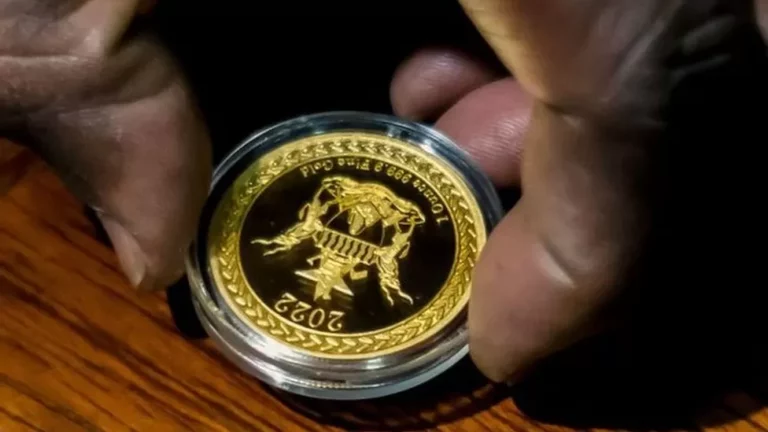
In a bid to address mounting economic concerns and prevent a return to dollarization, Zimbabwe has unveiled a gold-backed digital currency, named Zimbabwe Gold (ZiG). This initiative comes amidst growing worries over the stability of the country’s economy under President Emmerson Mnangagwa’s administration.
Zimbabwe’s central bank has launched ZiG, a digital token denominated in milligrams, offering accessibility to both individuals and businesses for everyday transactions. These tokens can be conveniently purchased from local banks using either the national currency or US dollars, with prices for goods and services now listed in ZiG.
Bank clients will be able to seamlessly conduct transactions using ZiG accounts, utilizing point-of-sale machines or online payment platforms for added convenience.
This move follows the introduction of physical gold coins in May, designed for peer-to-peer and peer-to-business transactions while also serving as a store of value amid the ongoing depreciation of the national currency.
Physical gold coin holders will now have the option to exchange or convert their holdings into gold-backed digital tokens through the banking system.
While this development has sparked diverse opinions, some economists and citizens remain cautious, fearing a potential return to dollarization due to the ongoing depreciation of the Zimbabwean dollar.
Zimbabwe had reintroduced its own currency in 2019 after a decade of dollarization, triggered by hyperinflation during Robert Mugabe’s tenure. However, the Zimbabwean dollar has faced swift devaluation against major global currencies. Recent reports indicate official exchange rates at ZWL$5,252 to $1, with the parallel market reaching as high as ZWL$10,000 to $1.
To safeguard the local currency during the height of the COVID-19 pandemic, the government implemented a multi-currency system. Today, it is estimated that roughly 80% of the country’s transactions occur in US dollars.
Advisory firm IH Securities noted a weakening official exchange rate from $1: ZWL$4,604,6233 to $1: ZWL$5,252,6558 between August and September, with similar trends in the parallel market. They anticipate continued pressure on the exchange rate.
Prices of essential commodities also surged, with some rising by 20% in September compared to August, according to the US’ Famine Early Warning Systems.
Economist Steve Hanke from Johns Hopkins University suggests that Zimbabwe should consider a return to dollarization, as it did from 2009 to 2019, as a viable solution.
Conversely, the Confederation of Zimbabwe Industries (CZI), representing the majority of the country’s major businesses, urges the government to explore measures that prevent full dollarization.
Foreign currency-denominated loans constitute a significant portion of the banking sector’s loan book, underscoring the need for the government to determine the optimal level of Zimbabwean dollar liquidity to avoid complete dollarization by default.
Robert Mubaiwa, head of Zimbabwe’s Victoria Falls Stock Exchange, emphasizes the importance of instilling market confidence for the success of a digital currency.
Zimbabwe’s gold sector plays a pivotal role in its economy, with last year’s production reaching 35.2 metric tonnes. This year, the government has set an ambitious target of 40 metric tonnes to boost mining sector revenues and breathe life into the struggling economy.
However, concerns persist regarding the illegal trade of gold through unofficial channels. A Qatar-based international news network recently exposed individuals allegedly connected to the political elite who smuggled gold to refineries in Dubai, with some claiming direct access to President Mnangagwa and his family. The country’s central bank has categorically denied any involvement in these illicit activities.
As Zimbabwe ventures into the realm of digital gold-backed currency, its ability to instill confidence in ZiG and ensure robust oversight will be pivotal in determining its effectiveness in addressing the nation’s economic challenges.
Source: techpointafrica
By: Montel Kamau
Serrari Financial Analyst
9th October, 2023